
Key Facts
- Metropolis of one million sweaty bodies: The August Street Parade transforms Zurich into the world's largest open-air techno rave, with over 1 million participants gathered around the lake.
- Disney Research Lab and Google Engineering Hub: Zurich hosts Google's largest engineering hub outside the United States and Disney's secretive lab dedicated to robotics, animatronics and artificial intelligence for Hollywood.
- 1,200 public fountains: Some dispense thermal water. Nobody buys bottled water. Bankers swim home through the Limmat River with their clothes sealed in waterproof bags.
Zurich is not what you think. It's far worse. In the best possible way.
Forget the cliché of the Swiss banker with the grey umbrella and the numbered account. Zurich in 2026 is something else entirely: a monstrous hybrid between a glacial amphitheatre of rare beauty and a technology laboratory where the future is being built — often in secret, often for Hollywood, almost always with money you cannot even begin to imagine. Welcome to the Swiss Cyber-Renaissance. Nobody warned you, did they?
Start with the geography, because nature here makes no aesthetic concessions. The city is wedged into a perfect "U" at the northern tip of Lake Zurich, from which the Limmat river emerges and cuts through the centre like a silver scar. To the west, Uetliberg mountain serves as a forested balcony overlooking the entire snow-capped Alpine chain. This is not a backdrop: it is a silent threat reminding you every morning exactly where you are. A city that has the Alps in miniature as its urban backdrop and still manages not to boast about it to tourists. Typically Swiss: perfection displayed with absolute discretion.
From the Middle Ages to the rusted container: the schizophrenic architecture
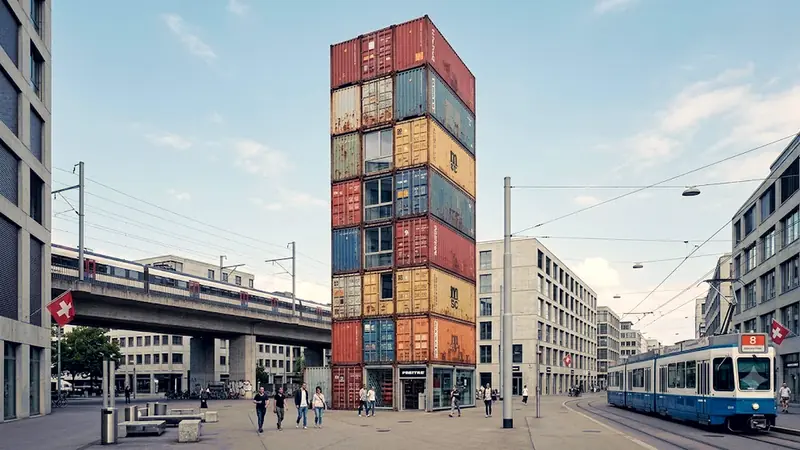
The old town is dominated by the Romanesque spires of the Grossmünster (the cathedral Zwingli used as a megaphone for the Protestant Reformation in the sixteenth century). Then you turn a corner and land in Zürich-West, and the temporal leap hits like a punch. What was once a decommissioned industrial district has become the most compelling neighbourhood in Europe — and that is said by someone who saw Shoreditch at its peak. Here stands Im Viadukt, a nineteenth-century railway viaduct whose brick arches now house design boutiques and restaurants with waiting lists stretching weeks. And then there is the landmark: the Freitag Tower, a high-rise built by literally stacking rusted shipping containers on top of one another. This is not a temporary art installation. It is a permanent building. It is the symbol of a city that takes industrial waste and turns it into iconic architecture. Recycling applied to urban planning (reusing materials as structural design). German academics write doctoral theses about it.
Google, Disney and the robots you never saw coming
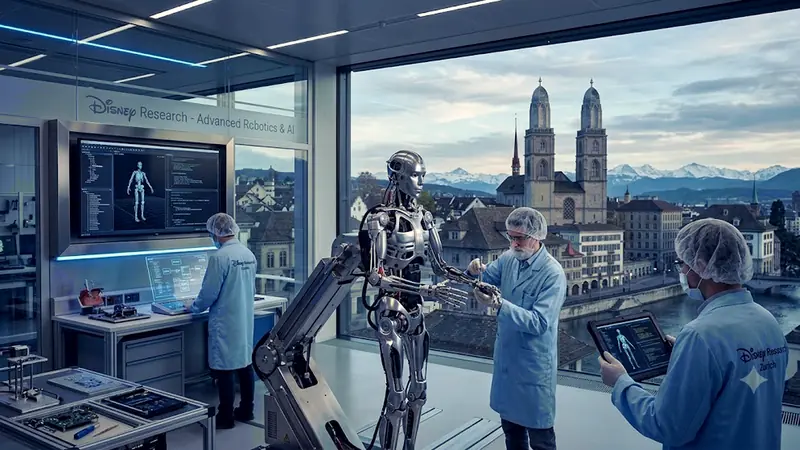
But Zurich's real secret lies neither in its museums nor in its Michelin-starred restaurants. It lies in the laboratories. The city is, without any possible dispute, the Silicon Valley of Europe — and that is not an honorary title: it is a functional description. The ETH Zurich Polytechnic (Federal Institute of Technology, consistently ranked top globally) has been producing the sharpest minds on the planet in robotics and artificial intelligence for decades, and those minds do not leave for San Francisco: they stay here, because serious work is done here. Google has established its largest engineering hub outside the United States in Zurich. Not a commercial office, not a representative headquarters: an engineering hub. Where things are built.
And then there is the detail that makes everything stranger: the Disney Research Lab. Secretive, discreet, embedded in this city of watches and chocolate. This is where the animatronic robots (lifelike mechanical figures for film and theme parks) and artificial intelligence systems that end up in Hollywood films and theme parks worldwide are developed. Zurich is literally building Disney's magic. Even the traffic lights, to close the technological loop, are governed by dedicated algorithms (self-optimising traffic management software): trams are mathematically guaranteed priority over private vehicles at all times. This is not urban courtesy. It is an equation.
The Langstrasse, the Badi and the exploding snowman
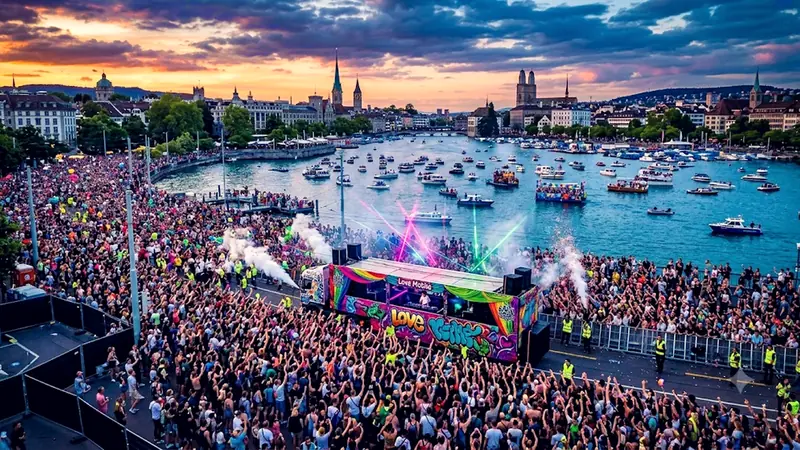
At night, the other face of the city shows itself without filters. Langstrasse, a former red-light district regenerated with the same chaotic energy as Zürich-West, is today a corridor of clubs open twenty-four hours a day, street food from every latitude, and a density of interesting people per square metre that is hard to replicate anywhere else. In August, all of this detonates into the Street Parade: the largest open-air techno rave in the world, with over one million people dancing behind music trucks around the perimeter of the lake. A city that debates robotics by day and dances to techno under Alpine stars by night. Consistency is not its strong suit. Fortunately.
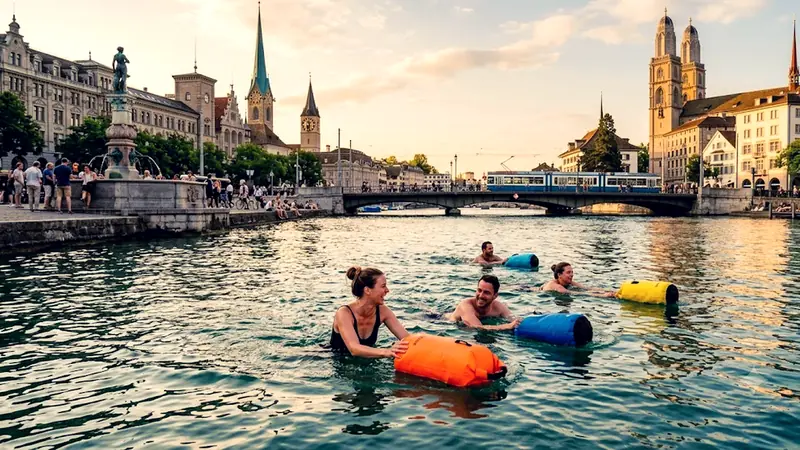
Daily life here has its own precise rituals. The Badi (public riverside bathing spot, a Zurich institution) is the sacred end-of-day rite: bankers, programmers and architects seal their clothes in waterproof bags and commute home by swimming down the Limmat River. This is not folklore. It is established practice. Every April, in an attempt to forecast the summer weather, the city burns the Böögg (a snowman effigy packed with fireworks): the faster it explodes, the sooner summer will arrive. Pyromaniac meteorology. It works about as well as standard climate models. The 1,200 public fountains scattered across the city make bottled water a conceptually alien object: some fountains even dispense thermal water. Zurich does not sell what it can give away for free. An ancient principle, a contemporary application.
In 2026, the city remains firmly among the top three in the world for quality of life according to all major international indices, with a cantonal GDP per capita exceeding 95,000 Swiss francs annually.