
Key Takeaways
- Exponential growth: Bitchat downloads surged 300% in Iran and 400% in Uganda during government-imposed internet blackouts.
- BLE mesh technology: the app harnesses Bluetooth Low Energy to build a decentralized network where every smartphone becomes a relay node.
- Direct competition: alternatives are emerging on the market such as ByteChat (Wi-Fi Direct), Bridgefy (Bluetooth), and Meshtastic, the latter capable of covering up to 15 kilometers via LoRa radio technology.
Communicating Without a Network: Bitchat's Mesh Revolution
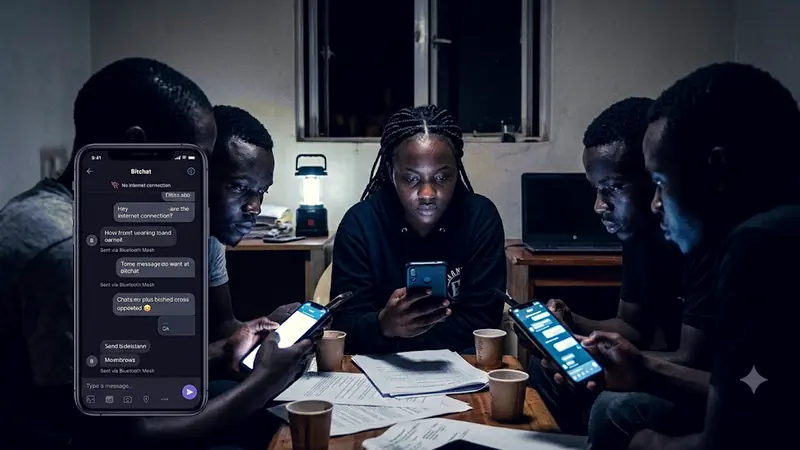
In a global landscape where control over digital infrastructure becomes a tool of power, Bitchat emerges as a concrete technological answer. The app overcomes the limits of traditional networks through a mesh system built on Bluetooth Low Energy: every device with the app installed acts as a repeater, allowing encrypted messages to bounce from one smartphone to another. This way, the theoretical 30-meter range of a direct connection extends considerably, creating a self-sufficient, distributed network. The absence of registration, phone numbers, or email addresses also guarantees a level of anonymity rarely found on other messaging platforms.

A Weapon Against Digital Censorship
The data confirms the urgency of the tool: during recent protests in Iran and Uganda, where authorities deliberately cut internet access to suppress dissent, Bitchat downloads spiked by 300% and 400% respectively. These numbers show that mesh technology is no longer a niche interest for enthusiasts, but an operational necessity for entire populations stripped of their right to communicate.
An Expanding Ecosystem
Bitchat doesn't operate in isolation. The sector is seeing growth in alternatives like ByteChat, built on Wi-Fi Direct, and Bridgefy, which relies on traditional Bluetooth connections. More ambitious still is Meshtastic, which thanks to LoRa radio technology reaches distances of up to 15 kilometers, opening up applications in natural disaster scenarios or remote areas lacking cellular coverage. These solutions are shaping a parallel communication ecosystem, independent of centralized infrastructure.