Key Points
- Record-breaking architecture: 6 uninterrupted kilometres of medieval sandstone arcades, recognised as UNESCO World Heritage.
- Swiss Fort Knox: Former anti-nuclear bunkers in the Bernese Alps converted into impenetrable Data Centers for billionaires and multinationals.
- Reitschule: An anarchist, self-managed cultural centre, tolerated by the Swiss State, epicentre of the punk and techno underground scene just metres from the Federal Parliament.
Bern: The World's Strangest Capital Doesn't Even Pretend to Be Normal
Forget Zurich with its double-breasted bankers and Geneva with its plastic-smiled NGOs. Bern is something else entirely. It is the federal capital of Switzerland, yet nobody seems willing to admit it — not even the Bernese themselves. It is a city that devours stone infants, hides underground theatres beneath its pavements, stores the digital secrets of the world's powerful deep inside its mountains, and lets its citizens hurl themselves into a glacial river as though it were any ordinary Sunday. Welcome to Europe's most underrated urban anomaly.
A Medieval Peninsula Suspended in Time (and in the Aare)
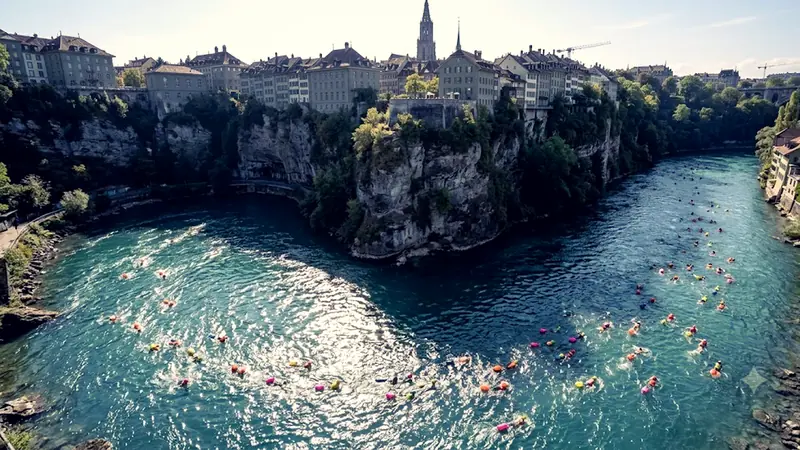
The first thing that strikes you about Bern is its shape. The river Aare carves a "U"-bend so tight and deep that it creates a rocky natural peninsula on which the entire historic centre sits. Emerald-green waters, lush hills, and in the middle this tongue of grey stone that seems to belong to no particular era. This is not scenography: it is morphology. The city is literally trapped in a geological embrace it has never tried to escape.
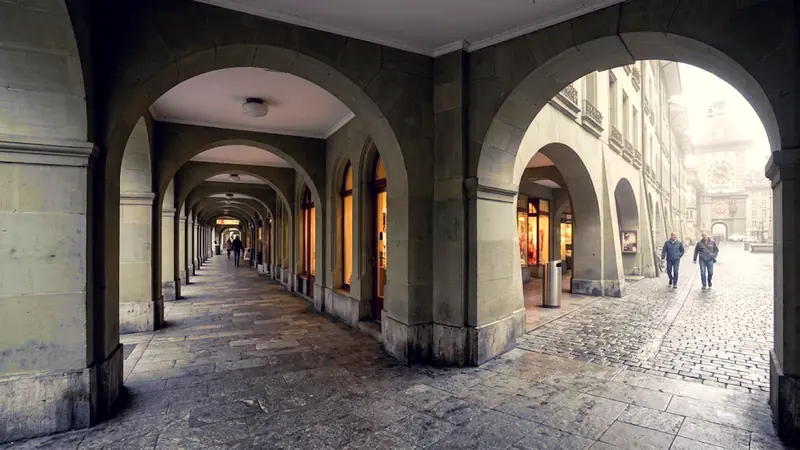
And that grey stone is no accident. Bern is built almost entirely from green-grey sandstone (a sedimentary rock giving the city its signature uniform hue), a material that lends it an almost oppressive chromatic uniformity — the kind of oppression that, over time, becomes an addiction. UNESCO included it among the World Heritage Sites, and for once UNESCO got it right. The primary reason is the Lauben, the arcades: six uninterrupted kilometres running the full length of the city. Six kilometres. You can cross Bern from one end to the other without catching a single drop of rain. A medieval infrastructure that many modern metropolises can only dream of.
But the real twist lies underneath. Beneath the pavements, accessible through angled trapdoors directly from the street, open the Kellergeschäfte (subterranean medieval cellars now housing theatres, niche boutiques and secret bars). A parallel city, literally underground, that hurried tourists will never see. Those who rush through Bern always miss something.
Einstein, Clocks and the Bunkers Where Billionaires' Secrets Sleep
This is not tourist-guide folklore: Albert Einstein developed the Theory of Relativity here, in this slow and stubborn city. And according to some accounts, part of the inspiration came from the mechanisms of the Zytglogge (a 16th-century clock tower dominating the Kramgasse), a pre-digital analogue computer, precise and relentless, that has been marking time for five hundred years. There is something deeply Bernese in this: slowness not as laziness, but as absolute precision.
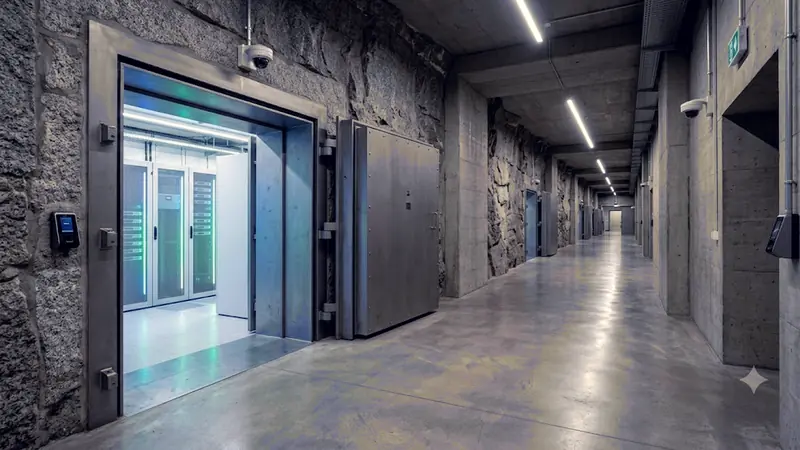
That same obsession with protection and precision has evolved into something far more contemporary and far less romantic. Deep inside the Bernese Alps lie the Swiss Fort Knox facilities: former military anti-nuclear bunkers, built during the Cold War to withstand a nuclear apocalypse, now converted into extreme-grade data centres. Inside these hollowed-out mountains sleep the data of billionaires, multinationals and governments that trust no commercial cloud. Energy redundancy, natural cooling guaranteed by the rock itself, physically armoured access. In an age where information is worth more than gold, Switzerland has simply moved its vaults from the surface into the mountain.
The Ogre, the Bears and State-Tolerated Anarchy Steps From Parliament
And then there is the side no institutional brochure wants to show you. In the heart of the historic centre, beneath which Bernese residents stop to chat with the serenity of someone waiting for a bus, stands the Kindlifresserbrunnen (the Ogre Fountain, dated 1546, depicting a giant in the act of devouring live infants). Nobody knows for certain what it represents, and this uncertainty seems to satisfy the Bernese perfectly — they feel no need to resolve it. The city also maintains a park with live brown bears, because the bear is the city's symbol and in Bern things are done in earnest.
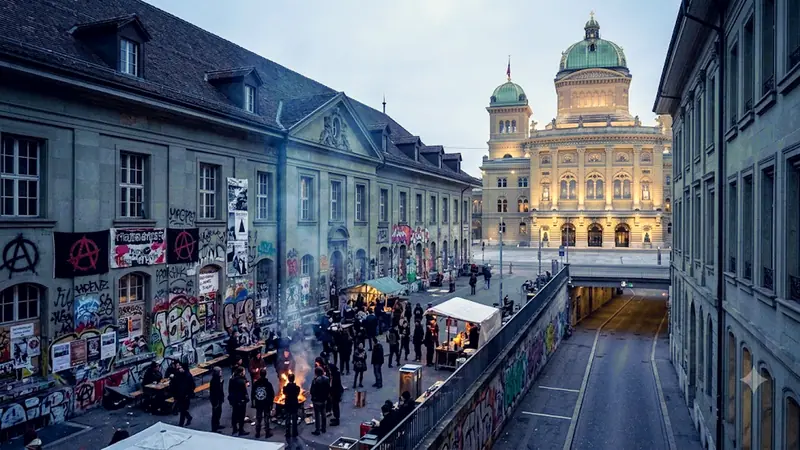
The ultimate contrast, however, is the Reitschule. A majestic former riding school, entirely covered in graffiti, a few hundred metres from the austere Swiss Federal Parliament. It is the country's most famous anarchist, self-managed cultural centre: punk concerts, techno nights, raw underground culture. The Swiss State has tolerated it for decades. It does not fund it, does not demolish it, does not normalise it. It simply lets it exist — like a thorn in its side that has stopped hurting.
Slowness as a Political Choice
Bernese Gemütlichkeit (a near-untranslatable German term for cosy, unhurried ease), that almost philosophical slowness that permeates every corner of the city, is not inertia. It is a deliberate posture. Anyone running through Bern's streets is met with suspicion, almost with pity. The quintessential summer ritual is Aareschwimmen (the practice of swimming in the Aare's current and drifting downstream for kilometres): you throw yourself into the cold, fast-flowing waters of the Aare and let the current carry you for kilometres, floating between the rocky walls of the peninsula. No resistance, no hurry. Only the current deciding.
By 2027, according to projections from the Swiss tourism sector, Bern is set to surpass Lucerne for the first time in international long-stay visitor flows — those remaining more than three nights. The market has understood what fast tourists still do not: cities that cannot be consumed in an afternoon are the only ones worth travelling to.