
Key Takeaways
- An evolving skyline: The second Roche Tower has reached 205 metres, surpassing its 2015 twin (178 metres) to become the tallest skyscraper in Switzerland.
- Architecture on display: The Novartis Campus, designed by Vittorio Magnago Lampugnani, brings together works by Frank Gehry, Tadao Ando, SANAA, David Chipperfield and Rafael Moneo along Fabrikstrasse, now open to the public.
- UNESCO heritage: Since 2017, the Morgenstreich, the ritual opening of Basel Carnival, has been recognised as an intangible cultural heritage by UNESCO.
The bend of the Rhine
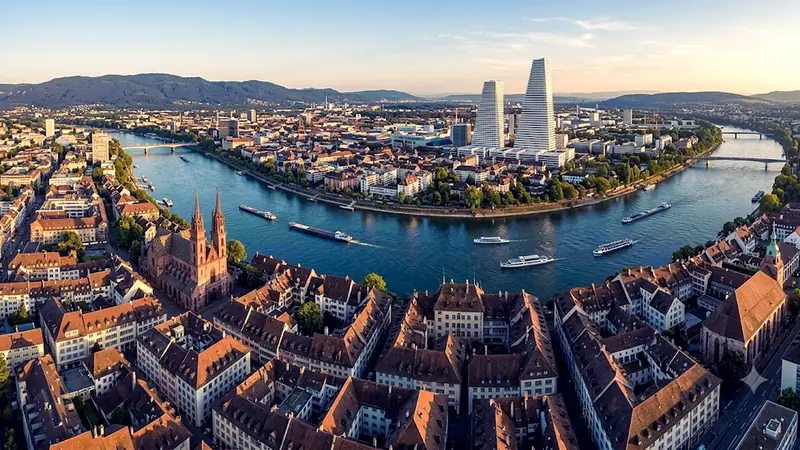
Basel sits at the point where the Rhine takes a sharp ninety-degree turn, a geographic kink that shaped centuries of trade history and remains the city's most recognisable feature today. It's Switzerland's only river port, a crossing point where the German Black Forest and the French Vosges look out over the same plain, forming a border territory where cultural influences overlap without hierarchy. Walking through the old town means passing through Gothic alleys that suddenly open onto squares dominated by glass-and-steel structures, a constant dialogue between eras that seeks no middle ground.
Concrete sails and science's forbidden city
Basel's skyline has been rewritten by local architects Herzog & de Meuron, the same firm behind Beijing's Bird's Nest stadium. Their Roche Towers rise like asymmetrical sails above the city's rooftops: the first, opened in 2015, reached 178 metres and stood for years as Switzerland's tallest building; the second, completed more recently, pushed that record to 205 metres, redrawing the visual horizon for the entire city.
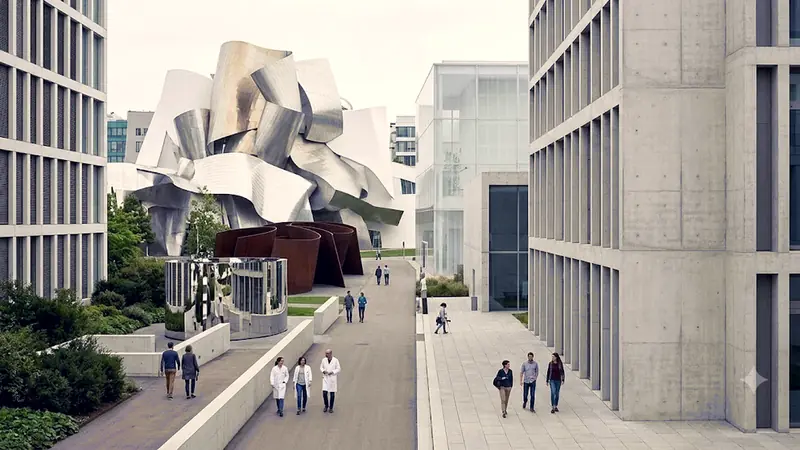
A few kilometres away spreads the Novartis Campus, a complex that stayed off-limits to the public for years and is now, fittingly, referred to as pharmaceutical research's "forbidden city." The masterplan, drawn up by Vittorio Magnago Lampugnani, turned the site into a living catalogue of contemporary architecture: each building carries the signature of a different name, from Frank Gehry to Tadao Ando, by way of studio SANAA, David Chipperfield and Rafael Moneo. The recent opening of Fabrikstrasse, an eight-hundred-metre stretch, now lets visitors walk through this collection of architectural landmarks alongside installations by artists such as Olafur Eliasson and Richard Serra, turning what was once an industrial enclosure into an open-air cultural trail.
The DNA lab and the engineless ferry
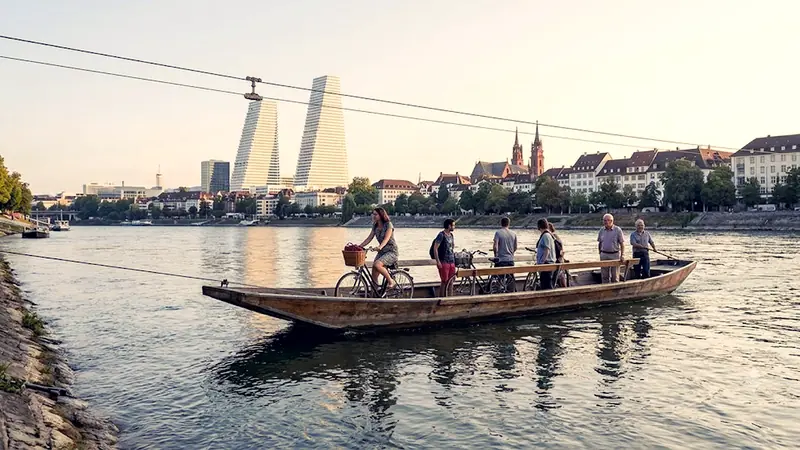
Basel is one of the world's key biotech hubs. Inside the labs of Roche and Novartis, research into gene therapies and DNA mapping draws scientists from across the globe. Yet just steps from these cutting-edge research centres, the Rhine is still crossed by four Fähri, historic passenger ferries with no engine at all. Pushed solely by the river's current and guided by a cable strung between the two banks, these boats still carry commuters from one shore to the other, an essential mode of transport that has barely changed over time. The contrast between labs mapping genomes and ferries powered only by the pull of water tells the story of a city with no need to smooth out its own rhythms.
Art, nightlife and a march through darkness
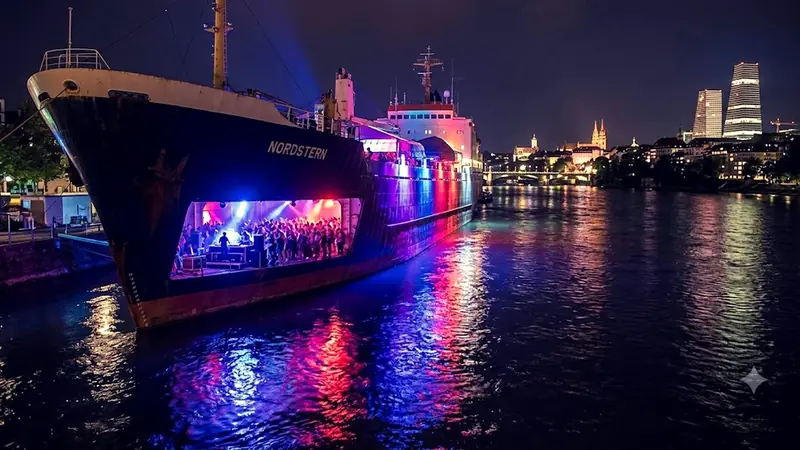
Every June, Basel becomes the centre of gravity for the contemporary art market with Art Basel, the fair that moves the industry's biggest figures globally and turns galleries, hotels and public spaces into one sprawling exhibition for a week. But it's after sunset that the city shows another side. Moored on the Rhine sits the Nordstern, a hulking Russian-built cargo ship whose hold has been converted into one of Europe's most renowned electronic music clubs, a place where the old hull's industrial creaks blend with the bass from the decks.
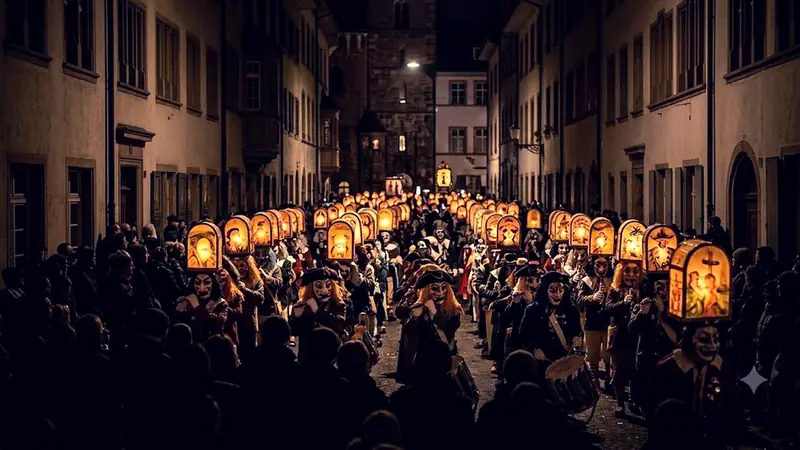
The most intense moment of the year, though, remains Basel Carnival, and above all its opening, the Morgenstreich. At exactly four in the morning, every light in the city goes out at once. Thousands of masked participants begin marching through total darkness, accompanied by the piercing sound of fifes and the beat of drums, their faces lit only by the glow of huge hand-painted lanterns carried on their heads or mounted on floats. No artificial lights break the scene: the entire city relies on darkness and lantern-fire for three days of non-stop parades. Since 2017, this tradition has been listed as intangible cultural heritage by UNESCO, a recognition that confirms the uniqueness of a rite with no equivalent elsewhere, still passed down through unwritten rules, generation after generation, among the city's carnival societies.