
Key Takeaways
- Volvo range and power: The EX90 and ES90 carry a 111 kWh battery pack, deliver up to 517 hp and 900 Nm of torque, with a claimed range of 700 km and DC fast charging up to 250 kW.
- SPA2 platform and LiDAR technology: Both models share the modular SPA2 architecture (Volvo's dedicated full-electric platform) running Google Automotive OS, a 14.5-inch Snapdragon-powered central display, and integrated LiDAR sensors for ADAS (Advanced Driver Assistance Systems).
- VinFast uses Chinese ports as logistics hubs: The Vietnamese automaker leverages Chinese maritime infrastructure as transhipment (intermediate relay port) nodes to streamline exports to North America and Europe, compressing global shipping costs.
Vietnam: A High-Voltage Dual-Track Play
Vietnam is no longer a backdrop. It has become one of the hottest arenas in the global electric transition, operating on two simultaneous and seemingly opposing fronts: importing zero-emission Scandinavian luxury while exporting its own electric SUVs using Chinese ports as a launchpad. A chess player's move, not a developing nation's reflex.
By the end of 2026, Volvo Cars will officially bring two of its most ambitious products to the Vietnamese market: the EX90 SUV and the ES90 sedan. This is not a routine rollout. It is a deliberate signal aimed at a customer segment Volvo has decided it can no longer afford to overlook. The local market is being treated as a final destination for premium products, not a clearance outlet.
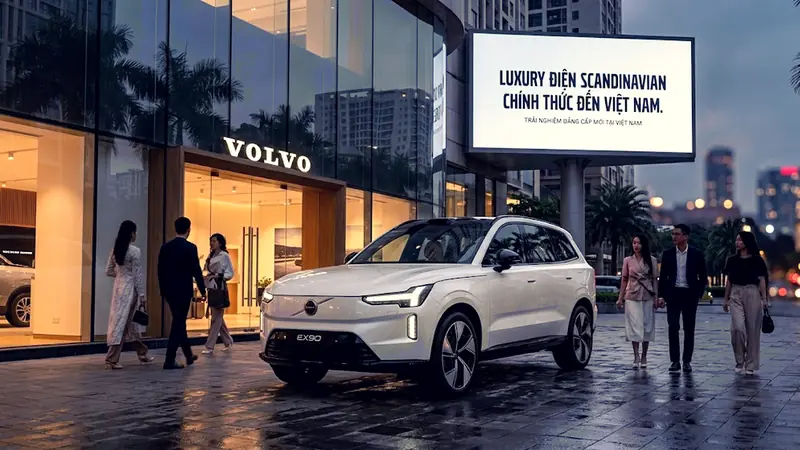
What's Under the Hood: SPA2 Platform and 111 kWh of Raw Power
Technically, both models are built on the modular SPA2 platform (Volvo's ground-up full-electric architecture). The battery pack is rated at 111 kWh, feeding a dual-motor layout — the so-called Twin Motor configuration — and the numbers that come out of this setup leave no room for romantic interpretation: output starts at 408 hp in base trim and climbs to 517 hp with over 900 Nm of torque in Performance variants. The kind of figures that physically rearrange your internal organs.
Claimed range reaches 700 kilometers on the official homologation cycle (standardized regulatory test), a figure the ES90 sedan — more aerodynamically efficient by geometric definition — is best positioned to approach in real-world conditions. DC fast charging accepts up to 250 kW, meaning a charging stop is no longer a disruption but a brief parenthesis. The electrical architecture is uncompromising and thoroughly modern.
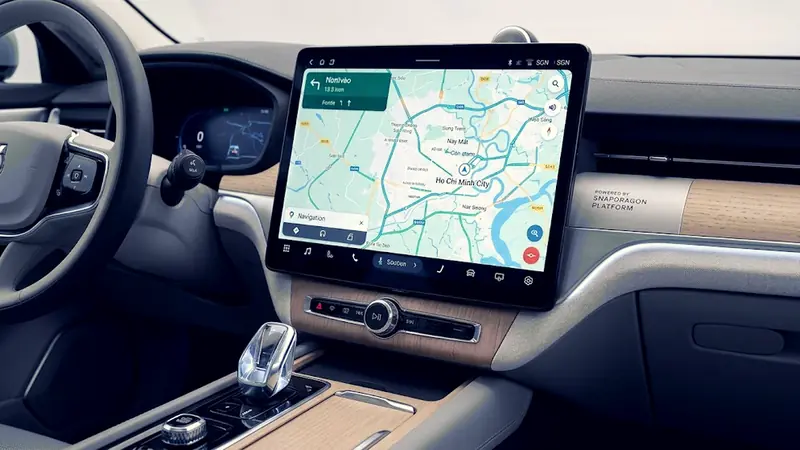
Inside, digital has taken full command. A 14.5-inch central touchscreen governs the entire experience, driven by the latest generation Snapdragon processors. The operating system is Google Automotive, natively integrated across infotainment, navigation, and connectivity. The ADAS suite relies on LiDAR sensors (laser-based 3D environment mapping) for continuous three-dimensional environmental scanning. This is not science fiction. It is production-spec hardware, 2026.
Flagship Pricing: EX90 and ES90 Take on Mercedes and BMW in Vietnam
On commercial positioning, Volvo is not hedging. The EX90 is expected to land in a range between 4.5 and 5.5 billion Vietnamese Dong, a figure that translates to approximately 160,000 to 200,000 euros, import and luxury taxes included. The ES90 sedan will follow with a comparable price point, targeting managers, executives, and the segment currently driving flagship electric vehicles from Mercedes-Benz and BMW.
This is not a volume strategy. It is an exclusivity strategy. Volvo is not chasing the mass market — it is chasing a specific buyer. Scandinavian design, a hard-earned safety reputation (both passive and active), and the technological signature of the SPA2 platform are the arguments on which the brand is building its commercial case in a market it has clearly decided is ready to receive it.
VinFast's Logistics Play: Chinese Ports as a Secret Weapon
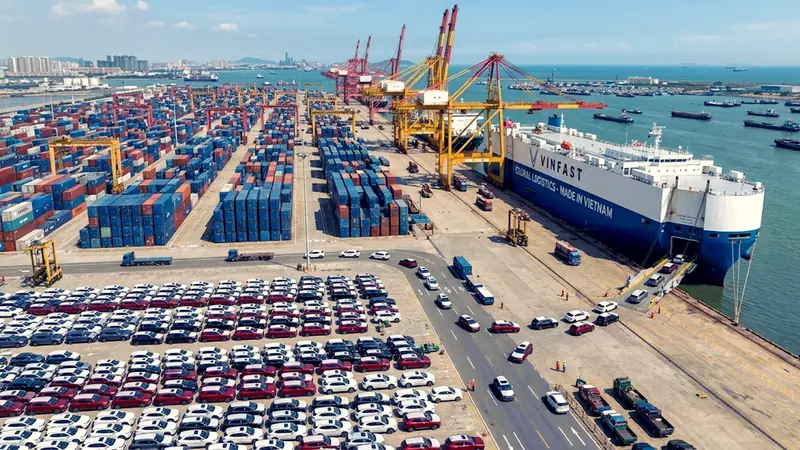
While Sweden moves in, Vietnam moves out. And it does so with a maneuver that has caught more than one analyst off guard. VinFast, the national automaker founded by conglomerate Vingroup, has concentrated thousands of vehicles across major Chinese ports. The surface-level reading — an attempt to crack the Chinese domestic market — is wrong. The correct reading is far colder and more rational: this is transhipment (using a third-country port as a relay hub).
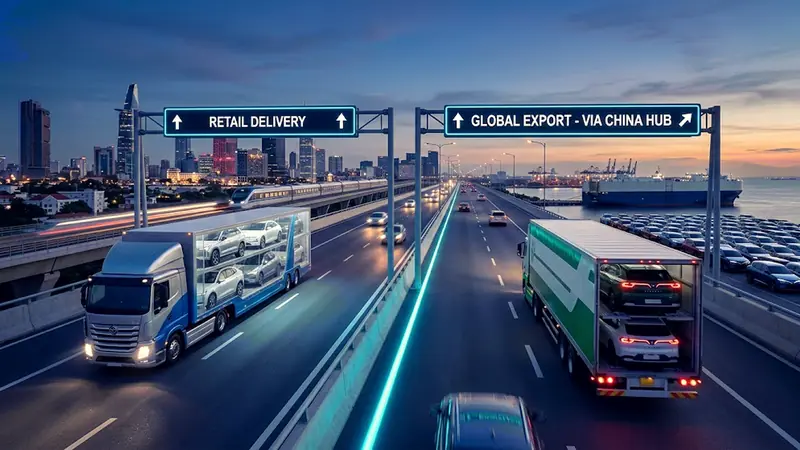
VinFast is using Chinese maritime hubs — among the most efficient and high-capacity in the world by volume and route frequency — as intermediate nodes to optimize its logistics chains toward North America and Europe. By bypassing the infrastructural bottlenecks of Southeast Asia, the Vietnamese automaker secures a steady outbound flow of its electric SUVs to target markets while simultaneously compressing global shipping costs. This is a move from a major automotive conglomerate, not an emerging startup.
Vietnam 2026: Strategic Node, No Longer a Simple Emerging Market
Placing both vectors side by side produces a picture that admits no ambiguity. Vietnam in 2026 is simultaneously a destination market for high-value-added electric products and an intercontinental export platform. Volvo brings in technology and premium positioning. VinFast ships out volume, leveraging third-party infrastructure with surgical precision.
This dual capability — absorbing and exporting, importing and orchestrating — is the definitive marker of an industrial maturation that can no longer be described through the categories of an emerging economy. Vietnam has become a node. On the global map of zero-emission mobility, ignoring it is no longer an option.