Key Points
- Subtractive approach: Contemporary 2026 design eliminates visual complexity to conceal advanced engineering within pure forms and organic materials such as cork, exposed aluminium and tadelakt.
- Key technologies: TPU polymers and nautical fabrics for hi-tech inflatable furniture, Peltier semiconductor cells in the 50-gram Hagibis magnetic heat dissipator, double-wall vacuum insulation in steel for thermal water bottles.
- Market impact: The "less is engineered" paradigm is simultaneously crossing urban mobility, interior design and pocket accessories, redefining the status symbol category within the premium everyday segment.
The Revolution You Cannot See
There is a revolution underway in design, and it is doing everything in its power to go unnoticed. It does not shout, it does not flash, it does not fire push notifications in your face. It works by subtraction, with a scalpel instead of a pneumatic drill. It is 2026, and the new luxury is no longer about adding layers of visible technology, but burying it so deeply that it becomes entirely invisible. Complex engineering disappears. What remains is form. What remains is material. What remains is silence.
Who understood this before everyone else? A handful of former designers who came out of Apple and Audi and decided to build an electric quadricycle called the Amble One. The concept is brutal in its simplicity: strip the automobile of everything that modern mobility has stuck onto it over the past twenty years. No doors. No invasive touchscreens turning the dashboard into a giant tablet. No plasticised surfaces that reek of counterfeit futurism. In their place, a steering wheel in cork — cork, you read that correctly — and exposed aluminium frames. The stated objective is to tear down the physical barrier between the driver and the landscape they move through, bringing the human body back into contact with urban space instead of sealing it inside a climate-controlled bubble. It is a short-range vehicle that has no desire to be a spaceship. It wants to be almost nothing.
The Bathroom No Longer Exists
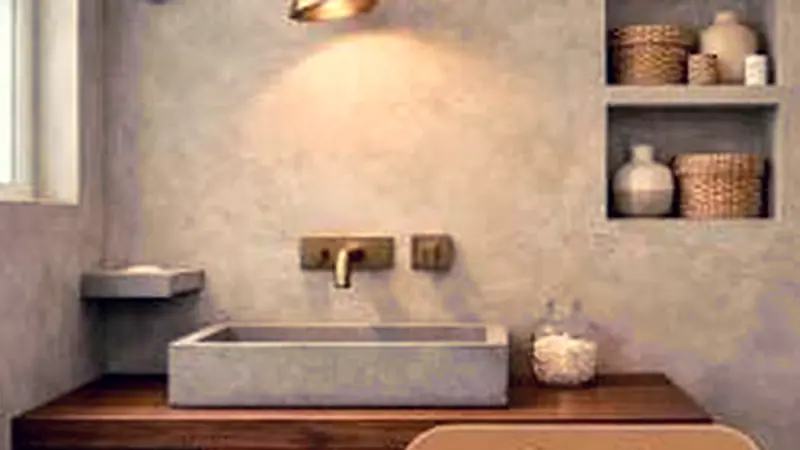
The same principle of dissolving boundaries has invaded domestic spaces with a silent aesthetic force. The bathroom — that utility room we treated for decades as a tiled storage cupboard — is officially dead. In its place exists something hybrid and without a precise name: a continuum between sleeping area and private spa, where surfaces in microcement and tadelakt replace anonymous ceramics with a raw and immediate tactility. Freestanding bathtubs are no longer plumbing fixtures. They are sculptural monoliths. Objects that occupy space with the same authority as a gallery sculpture.

And if the home dematerialises through its internal partitions, furniture responds to the same logic by taking it to its extreme conclusion: the piece that disappears when it is not needed. The revival of inflatable furniture has nothing to do with the plasticky nostalgia of the 1960s and its brittle, clammy PVC. Advanced polymers such as TPU and professional-grade nautical fabrics now make it possible to build sculptural seating that is structurally non-deformable, capable of travelling in flat-pack format and drastically reducing the logistical and environmental impact of transport. A sofa that weighs as much as a jacket. An engineering paradox packaged as a design object.

Fifty Grams of Thermodynamics
Scaling down further, to the objects that fit in a pocket, the philosophy does not shift by a single millimetre. The thermal water bottle has become, within just a few years, the most democratic emblem of this transition: double-wall vacuum insulation technology in steel, combined with industrial-grade powder coating finishes, has transformed a liquid container into an object that speaks the language of high fashion without betraying its primary function. Sustainability and status symbol fused into a matte steel cylinder.
But it is the Hagibis magnetic heat dissipator for smartphones that perhaps represents the most extreme and revealing case of this paradigm. Fifty grams in weight. Zero spring clips. Zero visual bulk. Inside, a semiconductor thermoelectric technology based on the Peltier effect — the kind of thing you would have found in research laboratories until just a few years ago, not magnetically attached to the back of a phone. The thermal problem of mobile devices, one of the most stubborn challenges in consumer electronics, solved with a minimalist magnetic attachment and completely silent operation. The most sophisticated engineering hidden inside the apparently most mundane object.

Luxury Is What Needs No Explanation
The common thread is always the same, from the macro-scale of the urban vehicle to the micro-scale of the pocket accessory: the pinnacle of engineering innovation in 2026 coincides with the highest degree of formal clarity. This is not minimalist aesthetics as a stylistic exercise. It is the direct consequence of a process in which complexity is resolved, not put on display. Materials work in silence. Technologies conceal themselves. Objects appear simple because an enormous amount of invisible work has made them so.
According to industry projections, the premium segment of everyday objects — water bottles, tech accessories, micro-mobility — is expected to record double-digit growth by the end of 2027, driven precisely by this demand for complexity hidden within essential forms.