
Key Takeaways
- Certified water yield: A single Warka Water tower collects between 40 and 100 liters of drinking water per day from atmospheric humidity (moisture suspended in the air), with zero electricity consumption.
- Technology and design: The system integrates a hydrophilic (water-attracting) polypropylene mesh, a bolt-free bamboo exoskeleton assembled using traditional joinery, and a shading tensile structure with a 3,000-liter cistern; the "Warka Tower 3.0" will add flexible solar panels to boost yield by up to 30%.
- Field operational impact: 2023–2024 pilot projects in Ethiopia, Cameroon, and Togo document the coverage of basic water needs for communities of 50 to 100 people per installation, with local training for autonomous maintenance.
Ten Meters of Structure Against Two Billion People Without Water
The number sits there, motionless and obscene in its brutality: 2.2 billion human beings have no access to safely managed drinking water. This is certified by the United Nations World Water Development Report 2024, published by UNESCO. Alongside that figure, another 3.5 billion live without adequate sanitation. In sub-Saharan Africa, according to the WHO-UNICEF Joint Monitoring Programme, women and girls walk an average of six kilometers a day to reach water sources that are often contaminated. Six kilometers. Every single day. Hours stripped from education, from work, from life. Against this backdrop, a ten-meter tower built from bamboo is becoming a concrete answer to a crisis that governments and large-scale infrastructure have failed to dent.
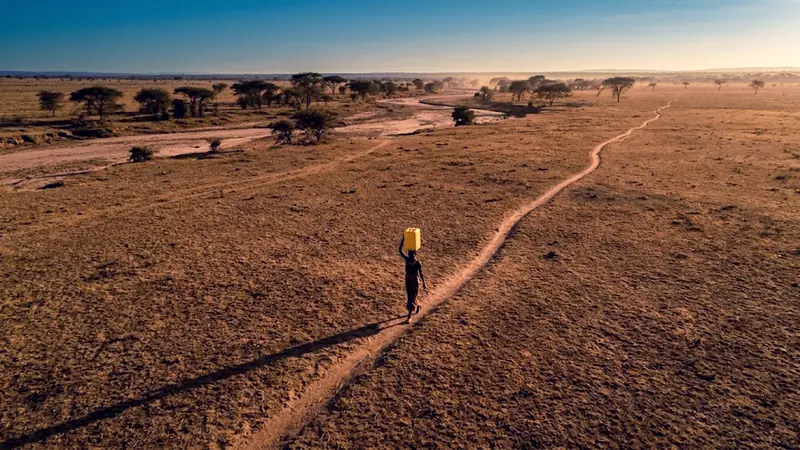
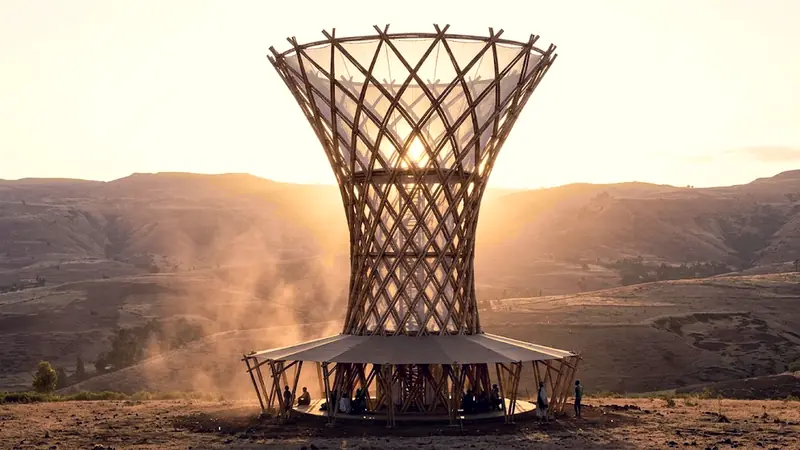
It is called Warka Water. It consumes zero watts of electricity. It requires no specialist technicians to operate. And it collects up to one hundred liters of water per day directly from the air. This is not science fiction. It is passive condensation (water collection through natural cooling, no machinery) applied with an engineering precision that many billion-dollar laboratories would struggle to replicate with equal simplicity.
The Physics of the Obvious That Nobody Had Built Yet
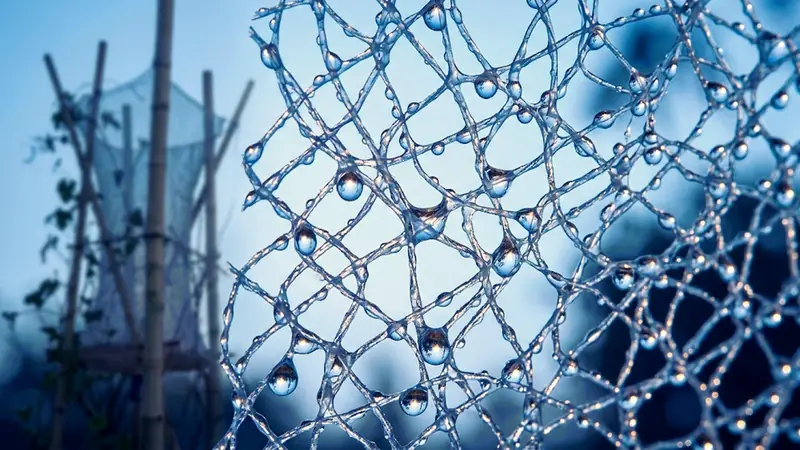
The principle is elementary: the atmosphere holds water. Even in semi-arid environments, humidity is present in the form of fog, dew, and micro-droplets invisible to the naked eye. The problem has never been the absence of water in the air, but the absence of a surface capable of intercepting it in useful quantities. Arturo Vittori, the Italian architect who founded the project, solved this problem with a three-dimensional polypropylene or nylon mesh engineered to maximize contact surface area with airflow. Even at low wind speeds, droplets collide with the hydrophilic (water-attracting) fibers, aggregate through surface tension, and flow downward by gravity into a channeling system. The material is UV-resistant and designed for years of operation without complex maintenance, as documented by the Warka Water Inc. team and in sector technical publications.
The load-bearing structure is made of bamboo canes, assembled using traditional interlocking techniques: no bolts, no industrial adhesives, no equipment unavailable in a rural village. The shape is not arbitrary. It echoes the Ficus vasta, the Warka tree of the Ethiopian highlands, a sacred site of community gathering. "We wanted to create a landmark that was also a place of social aggregation, not just a water machine," Vittori stated in an interview with Designboom. At the base, a textile membrane creates shade, reduces evaporation of the collected water, and acts as a supplementary funnel for rainfall. Everything flows into a 3,000-liter cistern with a tap. Nothing more.
From Lab to Field: What the Real Data Shows
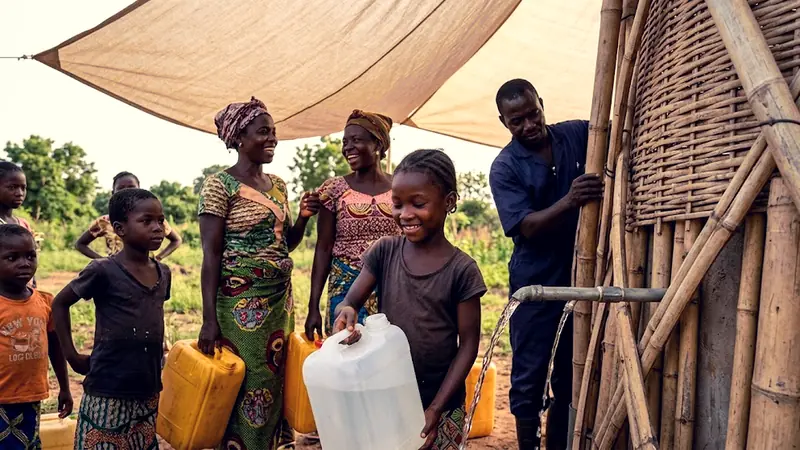
Between 2023 and 2024, pilot projects conducted in Ethiopia, Cameroon, and Togo, in collaboration with organizations including the Shining Hope Foundation, produced measurable data. A single tower collects between 40 and 100 liters per day depending on local atmospheric conditions — enough to cover the basic water needs of a community of 50 to 100 people. But the most significant figure is not the hydraulic one. It is the social one: every installation becomes a collective process. The local community participates in construction and is trained in autonomous maintenance. The model generates no dependency on external suppliers. It generates internal competence. Water frees women from the logistical burden of daily collection, returning hours that translate directly into education and the launch of micro-enterprises (small locally-run income-generating activities).
Version 3.0 and the Chitosan Frontier
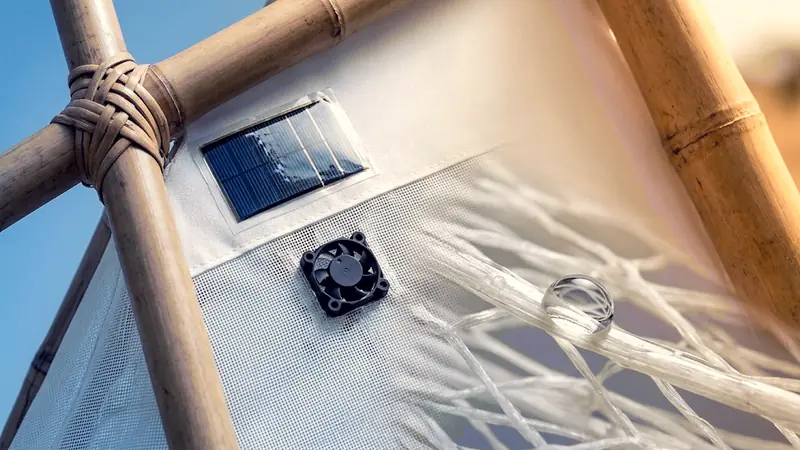
The team has not stopped. The Warka Tower 3.0 is in advanced development and integrates flexible solar panels to power a small fan capable of forcing airflow through the mesh during calm, windless hours. The projected outcome is a water yield increase of up to 30% — a significant leap in contexts where every liter counts. In parallel, in collaboration with African universities, the team is testing natural antibacterial coatings based on chitosan (a biopolymer derived from crustacean shells), applied directly to the mesh fibers. The goal is to guarantee the potability (drinkability without further treatment) of the water at the precise moment of collection, eliminating any need for subsequent filtration and further reducing the system's operational complexity.
According to UN-Water projections, by 2025 half the global population will be living in areas classified as water-stressed. The dominant technological response continues to focus on desalination, deep wells, and centralized infrastructure costing hundreds of millions of dollars. Warka Water proposes the opposite: radical decentralization, local materials, zero energy dependency, community management. A tower of bamboo and nylon that captures air and returns water. The data says it works.