Key Takeaways
- Date and source: In June 1900, in The Century Magazine, Tesla theorized an automaton equipped with "a mind of its own."
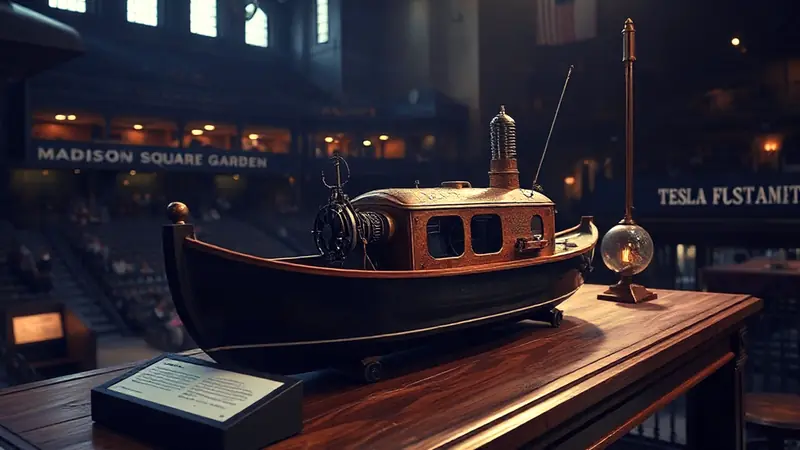
- Working prototype: The teleautomaton, demonstrated in 1898 at Madison Square Garden, integrated patents on radio, robotics, and a primitive logical AND gate circuit.
- Technical implication: The model of autonomous response to external stimuli anticipates the decision-making architecture found in today's AI systems.
The 1898 Prototype
The teleautomaton was not a remote-controlled toy. It was a system that integrated distance reception, mechanical actuation, and a primitive logical AND gate node. Tesla demonstrated it publicly at Madison Square Garden, two years before formalizing the theory on paper. The chronological sequence is clear: first came the working hardware, then the theoretical model.

An Anticipated Cognitive Architecture
In his 1900 essay, Tesla described a machine capable of operating "independently of any operator," reacting to "external influences" through "sensitive organs" to carry out operations "as if it had intelligence." The structure he described — sensors, processing, autonomous action — matches the perception-decision-action cycle of today's AI systems. A letter from 1890 clarifies the goal: not remote-controlled mechanisms, but machines endowed with their own intelligence. The time gap between concept and implementation spans over a century, yet the logical framework remains intact within current autonomous decision-making models.