Key Takeaways
- Reflect v1.0 at 90%: Flexion's system hits a 90% success rate grasping unknown objects during long-horizon autonomous missions (multi-step tasks requiring real-time reasoning).
- UBTech UWORLD U1 and Amazon Leo: UBTech's ultra-bionic humanoid robot surpasses 13,000 pre-orders at launch, while Amazon Leo's low-Earth orbit constellation reaches 396 active satellites.
- Meta Brain2Qwerty v2: Meta's non-invasive MEG (magnetoencephalography, brain-signal reading via wearable helmet) technology hits an average accuracy of 61%, peaking at 78%, unlocking concrete mass-scale neurological accessibility.
Summer 2026: Artificial Intelligence Stops Being a Prototype
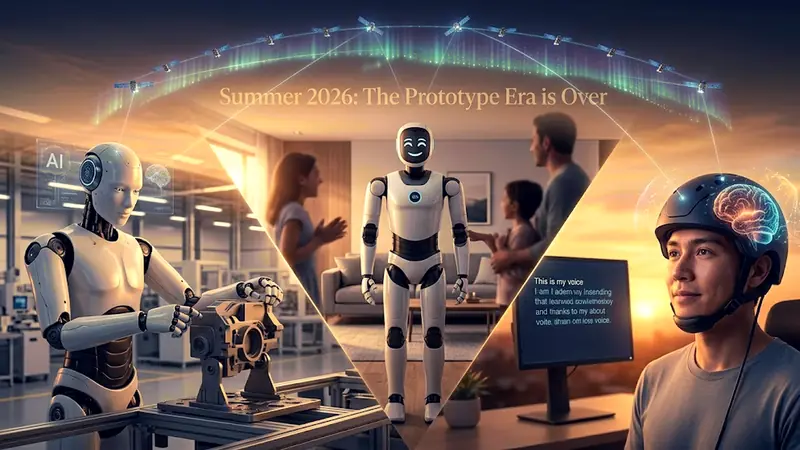
This is not a gradual evolution. It is a fracture. Summer 2026 is certifying, with hard data, that artificial intelligence and advanced infrastructure have definitively left research labs to become operational products, commercial services, and household objects. Four stories in the span of a few days. Four pillars of the same transition toward integrated automation and unprecedented global connectivity. The point of no return is now.
Reflect v1.0: The Robot That Thinks for Itself
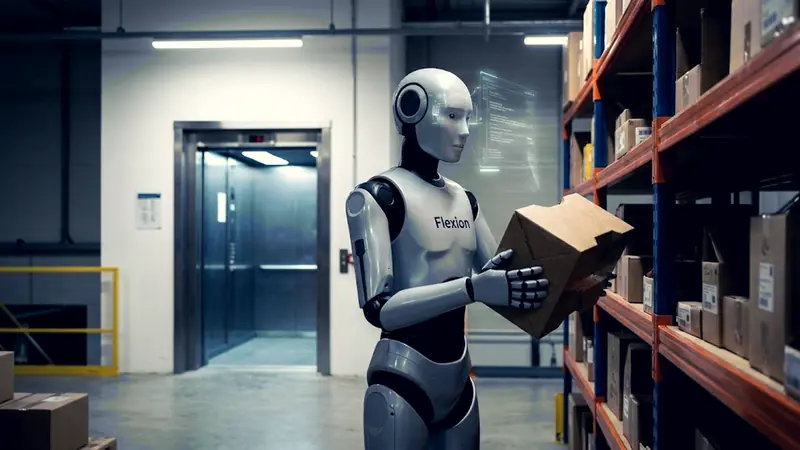
The problem with humanoid robots in industry has never been raw strength. It has always been the unexpected. That misplaced bolt, that slipped package, that obstacle that was not in the plan. Flexion has released Reflect v1.0 with the stated goal of burying this limitation once and for all, and the numbers appear to back that claim.
The system is designed for so-called long-horizon missions (multi-step tasks requiring sequential logic, adaptation and real-time correction): articulated sequences that demand reasoning, adaptation, and real-time correction. This is not about programming an automaton to repeat a single mechanical gesture. It is about issuing a complex instruction in natural language — "retrieve the package, use the elevator, unbox it and organize the items" — and letting it operate in total autonomy. The system records a 90% success rate grasping unknown objects, a benchmark that just a few years ago seemed like applied science fiction.
The architecture that makes this possible is hybrid by design. A Visual-Language Model (VLM, an AI that processes both images and text simultaneously) acts as the control center for spatial reasoning, while a reinforcement learning layer manages the physical fluidity of movement. Critical motor processes remain low-latency on local hardware; complex computations are offloaded to the cloud. The result is a system that self-corrects in real time: if an object slips, if a corridor is blocked, the robot recalculates. Without waiting for human instruction.
UBTech UWORLD U1: The Humanoid That Wants to Live With You
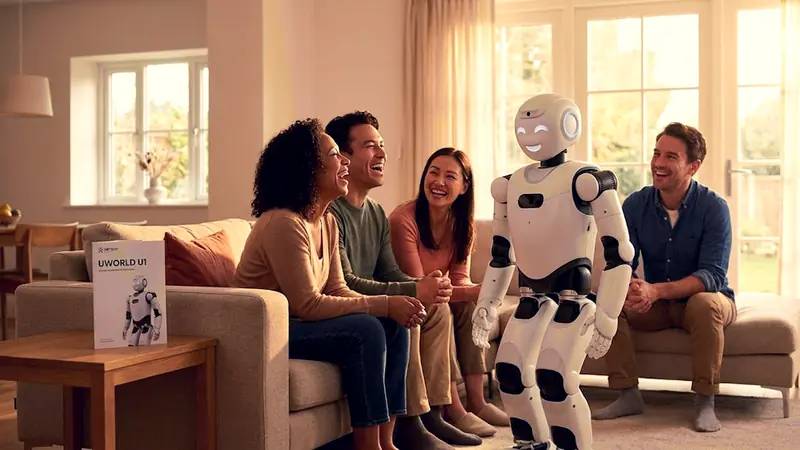
While Flexion targets factories, UBTech aims directly at living rooms. On June 30, 2026, the Shenzhen-based company unveiled the UWORLD U1 series, the first ultra-bionic humanoid robot explicitly engineered for mass production. In under twenty-four hours from launch: over 13,000 pre-orders. The lineup spans three variants — Lite, Pro, and Ultra — starting at 119,800 RMB.
The U1 is not a mechanical assistant with a polished shell. It integrates 88 degrees of freedom and, critically, the first emotion-aware LLM (large language model tuned to detect and respond to human feelings) ever mounted on a domestic humanoid. The system can recognize over 20 emotional states with accuracy exceeding 90% and responds with synchronized facial expressions in just 20 milliseconds. The latency is low enough to make the robot's reactions perceptually natural to the human eye.
On the privacy front, UBTech has adopted a local-first architecture (sensitive data processed on-device, not sent to external servers): sensitive data is processed directly on the device, minimizing cloud dependency. A technical choice that doubles as a commercial statement in a market increasingly sensitive to the issue of domestic surveillance.
Meta Brain2Qwerty v2: Reading Thoughts Without Opening the Skull
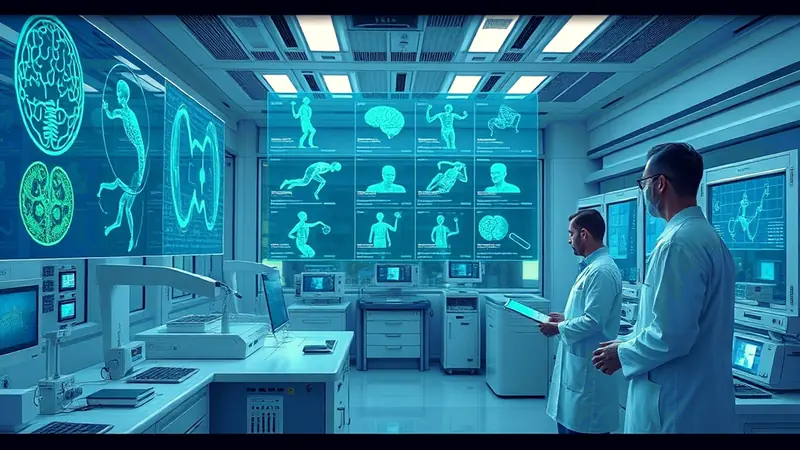
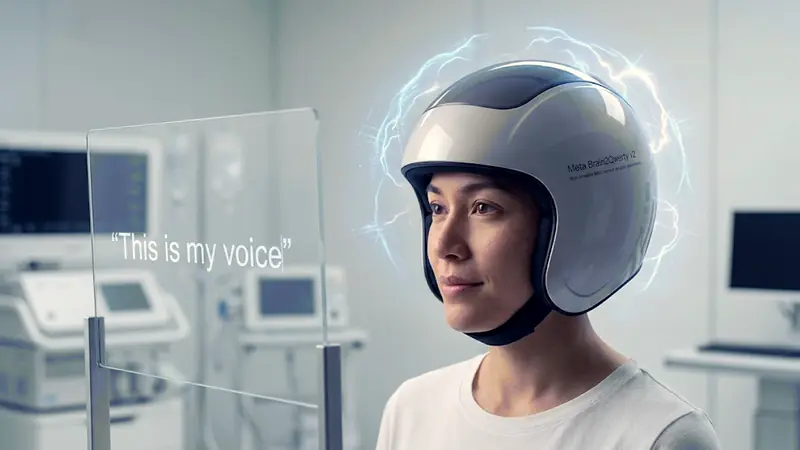
In the field of neural interfaces, the war between surgical and non-invasive approaches is wide open. Meta has chosen the second front, and with Brain2Qwerty v2 it is producing results that demand attention. Unlike Neuralink, which requires invasive brain implants, Meta has bet on magnetoencephalography (MEG, a technique that maps brain activity by detecting magnetic fields) via a wearable helmet. No scalpel. No operating room.
The system was trained on over 22,000 sentences and leverages end-to-end deep learning to decode thoughts directly from raw magnetic signals, translating them into written text. The average accuracy achieved is 61%, with peaks of 78% in subjects who respond best to testing. For a completely non-surgical technique, these are numbers that change the conversation. Integrated language models act as a neural autocorrect (AI layer that infers syntactic context to boost output accuracy), inferring syntactic context to increase overall accuracy. The stated goal is to restore communication to those living with paralysis, eliminating the clinical risks of cranial surgery.
Amazon Leo: 396 Satellites and the Chase After SpaceX
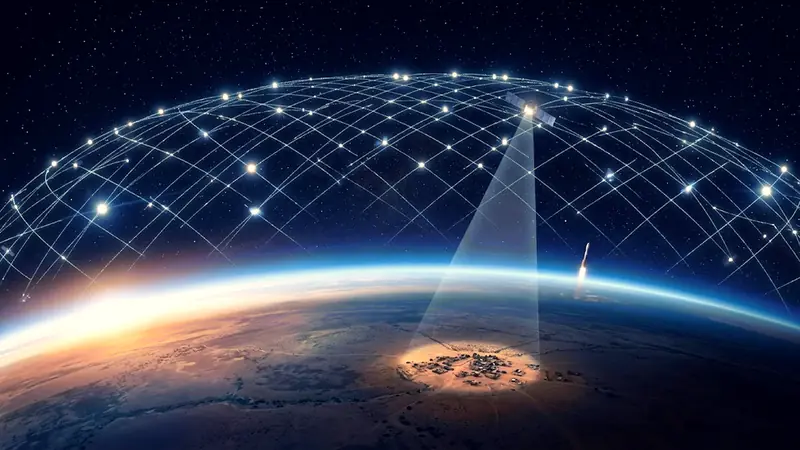
All of this data flow — reasoning robots, emotional humanoids, neural interfaces — requires a network. A global, continuous, gap-free network. On July 2, 2026, Amazon marked a concrete milestone for its former Project Kuiper, now rebranded as Amazon Leo. With the latest Atlas V rocket launch, the low-Earth orbit (LEO, satellite orbit between 160 and 2,000 km altitude) constellation reached 396 active satellites.
This number represents the critical mass required to launch broadband internet service across the first covered latitudes. Beta tests are expected in autumn 2026. From the next launch onward, Amazon will transition to the higher-capacity Vulcan Centaur rockets to accelerate deployment pace, targeting the federal deadline of 2029 to place all 3,200 satellites planned in the original blueprint into orbit. Total investment exceeds $10 billion. SpaceX still holds a structural advantage with Starlink, but the race is officially on.
Four stories. One direction. July 3, 2026 is not just another day on the technology calendar.