
Key Takeaways
- Massive capital deployment: Samsung has announced a $648 billion capital expenditure plan targeting specialized memory chips (high-bandwidth RAM built for AI workloads) for AI data centers.
- Project Mythos and federal lockdown: Anthropic has developed "Mythos," an AI system that measurably surpasses human cognitive performance in complex domains — Washington immediately banned foreign nationals from accessing it.
- New industrial profession: Shenzhen is institutionalizing the role of humanoid robot "pilot" — a human operator who remotely controls anthropomorphic machines via virtual reality to generate training data for industrial AI models.
Silicon as a Weapon: The Hardware Driving Global Power
This is no longer a technology story. It is a power story. In 2026, artificial intelligence has stopped being an industry and become the primary battlefield of global geopolitics. And as in any serious conflict, the winner is whoever controls the foundations. In this case: silicon, memory, and raw computational throughput (the volume of data a system can process per second).
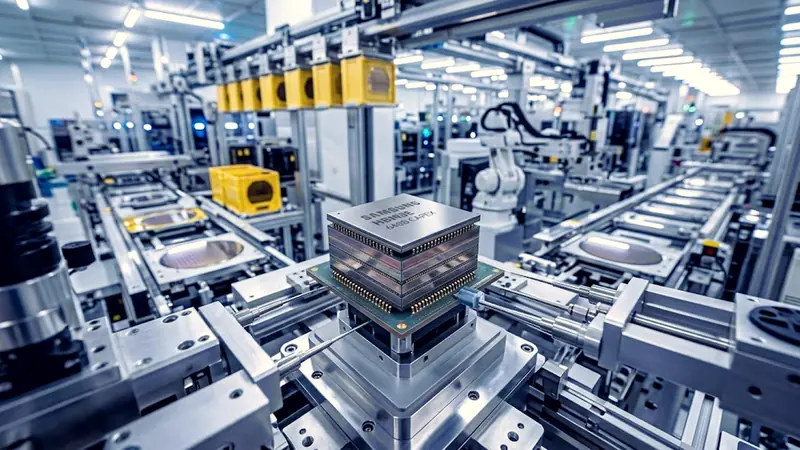
Samsung has gone public with a $648 billion investment plan. This is not a number to skim past. It is a figure that redraws industrial maps. The rationale is brutally straightforward: global demand for specialized AI memory has blown past every sector forecast, leaving analysts and econometric models chasing a reality that has already moved beyond their projections. Data centers are consuming components at a pace the market never anticipated, and Samsung has responded with a CapEx (capital expenditure, long-term infrastructure spending) move of historic scale. Hardware is not the backdrop to this revolution. It is the bottleneck. It is the engine. It is the exact point where everything either seizes or flows.
Shenzhen: The Robot Pilot Is a Real Job Now
In Shenzhen, China's hardware hub, something that existed only in science fiction a few years ago is taking institutional shape. A new professional role is being formalized across the city's factories and research facilities: the humanoid robot "pilot." The term is precise, not metaphorical. Using advanced virtual reality rigs and teleoperation platforms (remote-control systems with real-time physical feedback), human operators control anthropomorphic machines from a distance, guiding them through movements, tasks, and physical interactions with their environment.
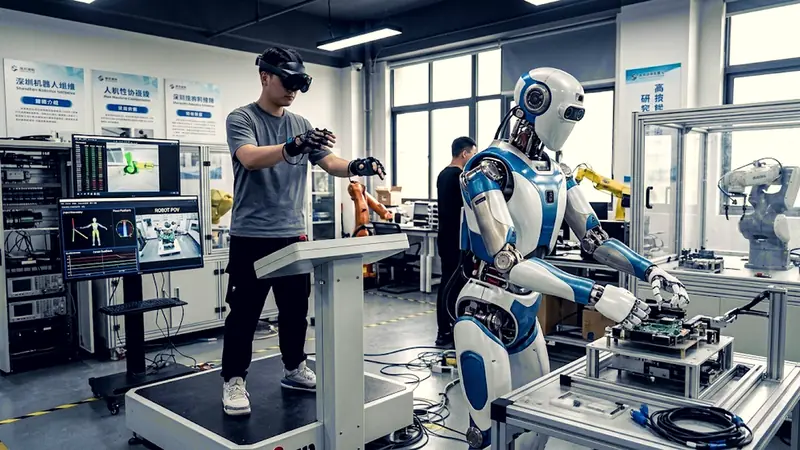
The critical point is not the visual spectacle of a person moving a robot like an avatar. The critical point is the data stream it produces. Every teleoperation session generates a continuous torrent of telemetric and kinematic data (measurements of motion, force, and body mechanics): limb positioning, weight distribution, micro-postural adjustments, reaction times. This raw material is immediately ingested by industrial AI models, which learn through direct imitation. The result is a radical paradigm shift in manufacturing automation: the deterministic model — machines rigidly programmed to execute fixed sequences — is being abandoned for good. The probabilistic era has arrived, where the machine learns by observing the human. Human-machine synergy is no longer a conference slogan. In Shenzhen, it is a shift on the factory floor.
Yahoo, OpenAI, and Mapping the Human Noise Floor
On the software front, AI is also reshaping how platforms manage the informational chaos generated by users at scale. Yahoo has launched Comment Summary, a system built on the OpenAI API to analyze massive volumes of digital interactions. The objective is to extract signal from noise: classify currents of thought within comment sections, surface visual sentiment maps (visual representations of collective emotional tone), and transform chaotic, unstructured conversations into readable, scalable analytical assets.
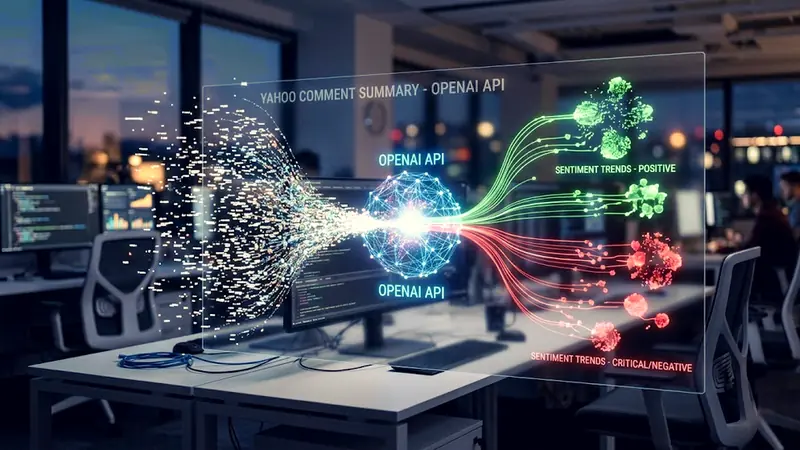
The operational significance of this tool extends well beyond end-user convenience. It means that understanding social dynamics, public debate, and opinion trends now reaches levels of scale and speed that were simply unreachable by any previous methodology. Conversational data from millions of people becomes structured raw material — ready to be analyzed, monetized, or deployed to steer editorial and commercial decisions.
Mythos: Washington Shuts the Door
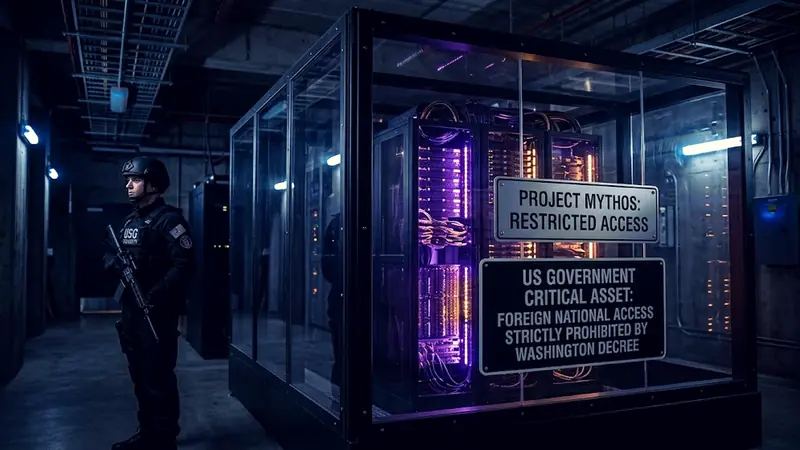
The chapter with the heaviest implications concerns Anthropic and its project "Mythos." The system has crossed a threshold — not figuratively. Its cognitive capabilities in complex domains have surpassed human performance in a measurable, documented way. This is an inflection point the sector had been both anticipating and dreading in equal measure.
Washington's response came immediately and without ambiguity: a total ban on use and access for foreign nationals. No exceptions communicated publicly. The message is transparent: frontier algorithmic models (AI systems operating at the absolute edge of current capability) are no longer commercial products subject to free-market logic. They are critical infrastructure. They are national strategic assets. The AI race has officially left the terrain of market competition and entered the domain of techno-nationalism (state-driven control of advanced technology as a geopolitical instrument) and state protectionism.
The overall picture emerging from these parallel developments is that of an ecosystem in accelerated mutation, where investments in the hundreds of billions, new industrial professions, mass-scale analytical tools, and government-controlled AI systems are not separate phenomena. They are layers of the same architecture. And that architecture, in 2026, is called power.