
Key Takeaways
- Technical goal: PsiQuantum is targeting a quantum computer with roughly 1 million qubits, operational by 2027.
- Technology: The Omega photonic chipset integrates Barium Titanate with a Fusion-Based Quantum Computing architecture.
- Capital and sites: A $1 billion Series E round (valuing the company at $7 billion), with facilities under construction in Moreton Bay (Australia) and Chicago.
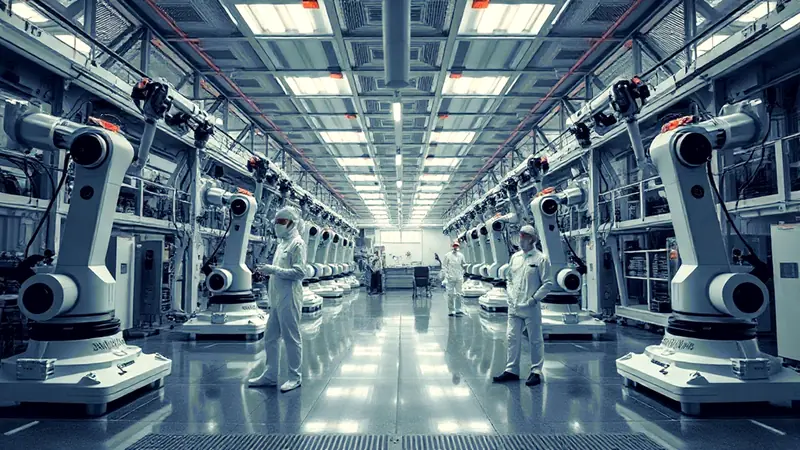
PsiQuantum broke ground on June 18, 2026, on its first industrial-scale facility at Moreton Bay Central, Australia. The site will house roughly 100 stainless-steel racks, each two meters tall, linked to a liquid-helium cryogenic system ordered from Linde Engineering back in 2024 and slated for delivery in the second half of 2027.

Founded in 2016 by four British physicists, the company builds qubits by manipulating single photons on silicon photonic chips — the same technology used in telecommunications and data centers. This approach lets components be manufactured in existing semiconductor fabs, such as GlobalFoundries' facility in New York, sidestepping the need to build dedicated production lines.
The Omega Chipset
In February 2025, PsiQuantum unveiled Omega, a photonic chipset engineered to operate at a scale of millions of qubits. Single-photon sources, superconducting detectors, and optical switches are integrated with Barium Titanate, an electro-optic material that routes photons with high precision and speed. The system runs on a Fusion-Based Quantum Computing architecture, which handles error correction through measurement operations between "fused" qubits rather than isolated ones.
Two Build Sites, Two Governments
Alongside the Australian site, PsiQuantum is building a second facility in Chicago, working with local U.S. authorities. The U.S. Department of Commerce awarded the company $100 million under the CHIPS Act. The Trump administration has also signed letters of intent worth $2 billion spread across nine quantum companies, taking equity stakes in each; PsiQuantum is among the recipients.

Investors and Valuation
In September 2025, PsiQuantum closed a $1 billion Series E round, pushing its valuation to $7 billion following an interim mark of $6.3 billion in May 2026. Backers include BlackRock, Temasek, Baillie Gifford, the Qatar Investment Authority, and NVentures, NVIDIA's venture arm, with which the company has also launched a technical collaboration on quantum algorithms and GPU-QPU integration. The company currently employs 588 people.
Planned Applications
Among the use cases cited by the company is the simulation of cytochrome P450 enzymes, responsible for metabolizing most drugs in the human body. Calculating these interactions currently requires more than 10 years of processing time; PsiQuantum's stated goal is to cut that down to four minutes.
Co-founder Pete Shadbolt has said the company now has the chips, switches, scalable cooling technology, networking capability, identified sites, and government backing needed to move forward with industrial-scale system construction. The machine is expected to be hardware-ready by 2027.