Key Takeaways
- The decline of Prompt Engineering: According to Andrew Ng, hand-written prompts will disappear within 3-6 months, replaced by autonomous loop systems.
- Mass adoption at Anthropic: 80% of the company's engineers already use self-improving loops in their daily workflow.
- A three-tier architecture: The workflow is structured into the Agentic Coding Loop, the Developer Feedback Loop, and the External Feedback Loop, moving from the fastest cycle to the most strategic one.
The end of the perfect prompt
A paradigm shift is unfolding in AI-driven software development, redefining the relationship between programmer and machine. The term Loop Engineering, coined in June 2026 by Google Chrome engineer Addy Osmani, is rapidly displacing Prompt Engineering as the reference discipline for those working with generative AI agents applied to code. The very concept of the "perfect prompt," which for months stood as the primary goal for developers and technical teams, is now considered an outdated approach, unable to scale against the complexity of modern systems.

The core difference lies in the object of human labor itself. It is no longer about crafting increasingly precise textual instructions to feed a language model, but about designing autonomous architectures in which AI agents iterate independently until the assigned task is complete. The phrase that best captures this shift comes from Boris Cherny, an engineer at Anthropic, who stated: "I don't write prompts to Claude anymore, I have loops that write them for me." A statement that signals just how much the level of abstraction in the human-machine relationship has risen.
Andrew Ng's three concentric loops
Andrew Ng, a leading figure in the machine learning field, has given theoretical structure to this new operating model, breaking the workflow down into three concentric loops that run at different speeds and serve different purposes. The first, called the Agentic Coding Loop, is the fastest cycle: here the AI writes, runs, and tests code in autonomous sequences that wrap up within minutes, with no direct human intervention during execution.
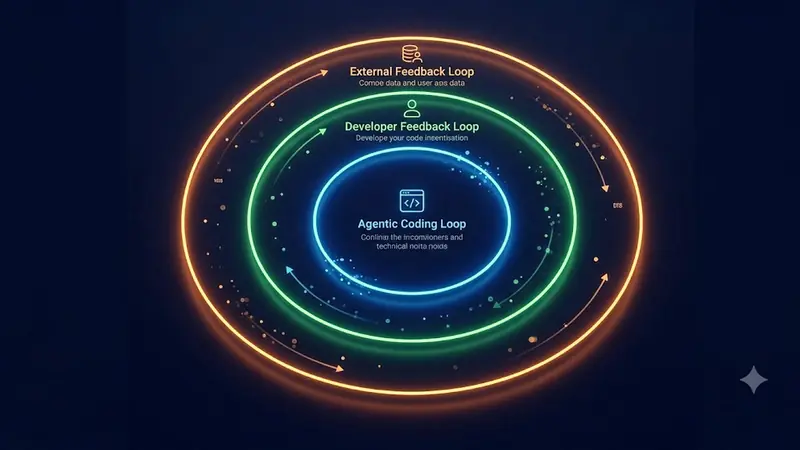
The second tier, the Developer Feedback Loop, brings the human back into the center of the process, but with a different role than before: the programmer no longer writes detailed operational instructions, but instead defines the overall context and business constraints within which the system must operate. Finally, the External Feedback Loop closes the circle by feeding real data collected from end users back into the system, allowing for continuous product improvement based on actual behavior rather than theoretical assumptions.

A concrete test: one hour of autonomy
Ng himself gave this theory concrete form by documenting a hands-on experiment: he tasked an AI agent with building a video game for his daughter. The most significant result wasn't the finished product, but the process behind it: the system tested and fixed the code autonomously for nearly an hour, with no manual intervention along the way. In a traditional development setting, that stretch of time would have called for repeated cycles of writing, debugging, and checking by a human programmer.

This kind of practical demonstration reinforces Ng's boldest prediction: "In 3-6 months, prompts will die, replaced by loops." A statement that, however categorical, finds empirical backing in internal Anthropic data showing that 80% of the company's engineers already use self-improving loops in their day-to-day development work. This is not an isolated projection, then, but a trend already measurable inside one of the most advanced organizations working with language models applied to programming.
The engineer's role is changing shape
The essence of the shift described by Loop Engineering is radical, touching the very redefinition of engineering work in the age of generative AI. The human stops being the direct executor of instructions to the machine and becomes instead the designer of the system within which the machine operates autonomously. No longer writing the single command, but building the logical infrastructure that lets the agent iterate, verify, correct, and complete a task without constant supervision.

This shift carries direct implications for the skills developers will need going forward. Where Prompt Engineering rewarded the ability to craft precise linguistic instructions, Loop Engineering demands systems architecture skills, the ability to define constraints and success criteria, and a big-picture view of the production cycle stretching from code writing to real user feedback. The programmer, in other words, moves from an operational role to one of strategic oversight.
It remains to be seen how quickly this paradigm shift will spread beyond frontier companies like Anthropic, and whether Ng's prediction of a timeline measured in months will hold true as the broader software development industry moves toward wider adoption. What already seems clear, based on the available data, is that the autonomous loop model is no longer a niche experiment, but a concrete trajectory the industry is decisively moving toward.