
Key Points
- Government Control Over AI: OpenAI's GPT-5.6 released exclusively to selected partners under direct supervision of the United States government.
- Cybersecurity Benchmark Supremacy: GPT-5.5-Cyber surpasses Anthropic's Claude 5 in vulnerability detection across large codebases.
- China's Challenge to the West: GLM-5.2, an open-source model developed in China, achieves performance superior to major Western competitors.
The Great Control: Washington Takes Hold of GPT-5.6
Welcome to 2026, where artificial intelligence is no longer just a technological matter but literally a state affair. OpenAI has released its latest frontier model, GPT-5.6, but don't expect to find it on the open market like some ordinary smartphone update. The United States government has decided to get involved, imposing a controlled distribution system that limits access exclusively to pre-selected and pre-approved partners. This is the first time in recent history that an American administration has exercised direct and declared control over the distribution of a commercial frontier artificial intelligence model. It's not science fiction, not a dystopian film: it's the reality of June 26, 2026.
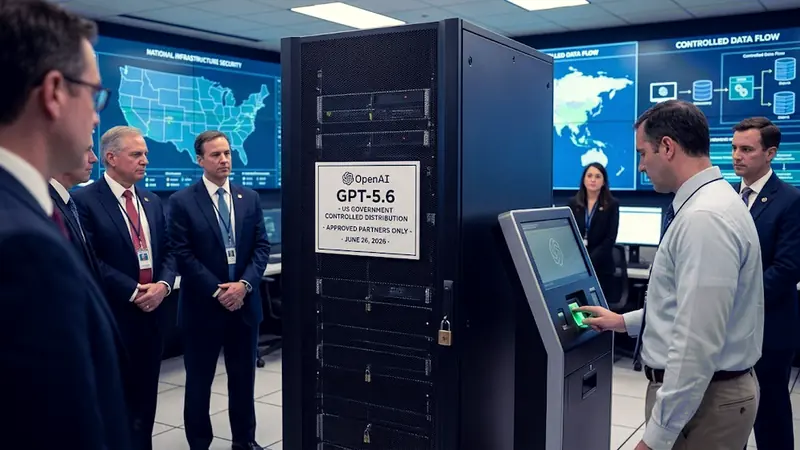
The move is neither casual nor improvised. Behind it lies a precise geopolitical strategy that responds to mounting pressure from multiple fronts. The signal is unmistakable: AI is critical national infrastructure, exactly like nuclear energy or military communications. Anyone who thought Silicon Valley could continue to play alone, without federal supervision, was badly mistaken.
The Model Wars: OpenAI Dominates Cybersecurity, China Responds
While Washington tightens its grip on distribution, on the technical front the battle between AI giants is becoming increasingly fierce. OpenAI has upgraded GPT-5.5-Cyber, its model specialized in cybersecurity, and the benchmark results speak clearly: it surpasses Claude 5 from Anthropic in vulnerability detection within large codebases. This is no minor victory. In an era where every critical infrastructure — from power grids to hospitals — runs on potentially compromised software, having the most performant model in detecting flaws before someone exploits them is a competitive advantage worth billions. And probably some government contracts of the kind that don't end up in press releases.

But while OpenAI celebrates its supremacy in the cyber field, from the east comes a response that is shaking the certainties of the Western tech establishment. GLM-5.2, the new open-source artificial intelligence model developed in China, has reached and in some cases surpassed the performance of major American competitors. Open-source, accessible, performant. It's the combination that frightens those who built their competitive advantage on secrecy of weights and restricted access. The American monopoly on frontier AI, if it ever truly existed, is showing increasingly deep cracks.
Singapore and Chips: Hardware is the New Oil
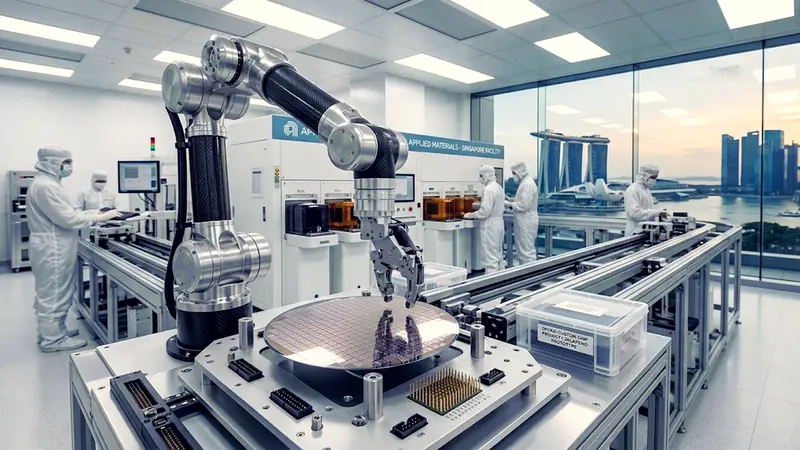
The game is not played only on models and algorithms. It's played on silicon, on wafers, on foundries. Applied Materials is the latest major company in the sector to expand its operations in Singapore, consolidating the Republic as a strategic hub of the Asian semiconductor ecosystem. It's not a casual choice: Singapore offers political stability, world-class infrastructure, and a geographic position that makes it a crucial node in global supply chains, especially at a time when the geopolitical redistribution of chip production has become an absolute priority for Washington, Beijing, and Brussels.
And while foundries multiply, major AI players have decided to stop depending on Nvidia. OpenAI, Google, Microsoft, and Amazon are investing massively in designing proprietary processors. OpenAI's internal project, code name Jalapeno, aims to reduce operating costs, energy consumption, and above all dependence on a single supplier that in recent years has accumulated unprecedented market power. When four of the world's most capitalized companies simultaneously decide to build their own chips in-house, the message for Jensen Huang is quite clear.
Deepfakes, Disinformation, and Digital Medicine: The Rest of the World Adapts

The Japanese Ministry of Defense has presented a structured strategic plan to address so-called cognitive warfare: deepfakes, disinformation campaigns, coordinated fake accounts. Tokyo is not improvising: the plan includes strengthening national information capabilities, integrating AI into response systems, and coordinated protocols to neutralize hostile campaigns before they reach critical mass. It's the institutional response of a mature democracy to a threat that many governments still struggle to define with precision.
On the opposite end of the application spectrum, Japanese startup CureApp demonstrates that AI can do much quieter and equally revolutionary things. Transforming therapeutic protocols into usable digital applications, extending access to care beyond the physical boundaries of traditional healthcare facilities: it's precision medicine meeting digital distribution. A market that, according to the most conservative projections, will be worth tens of billions by the end of the decade.
The overall picture on June 26, 2026, is that of a sector that has definitively transformed into a geopolitical arena: the next eighteen months will determine which governments, which companies, and which models of AI governance will survive the first true phase of global consolidation.