Key Takeaways
- Energy autonomy: An implantable biofuel cell developed at Case Western Reserve University converts trehalose produced by the cockroach into electricity, with no long-term harm to the insect.
- Cutting-edge tech: The Beijing Institute of Technology has built a 46 mg piezoelectric harvester for bees, capable of generating 5.66 V by capturing thoracic vibrations without compromising flight.
- Military interest: German startup SWARM Biotactics has already run operational tests with NATO-affiliated clients for deploying cyborg swarms in surveillance and reconnaissance missions.
When Biology Becomes Hardware
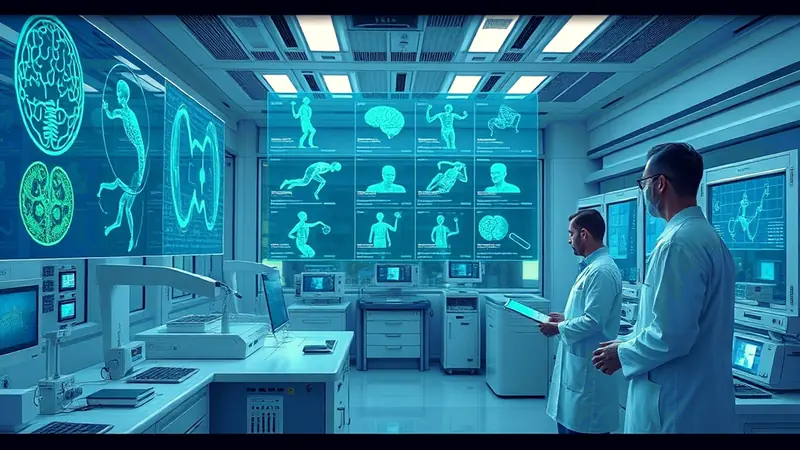
The fusion of flesh and circuitry is no longer science fiction projected onto a screen. It's an active, ongoing project producing measurable results. Cyborg insects represent one of the most concrete frontiers of hybrid robotics today: not machines that imitate nature, but living organisms fitted with miniaturized electronics that guide their movements through targeted electrical stimuli. The difference from traditional micro-robots is substantial. This isn't about artificially replicating a cockroach's agility or a bee's endurance — it's about borrowing their muscles, their biomechanical efficiency, their nervous system directly. The result is energy consumption drastically lower than any fully synthetic drone or robot of comparable size.
The Power Problem, Solved From Within
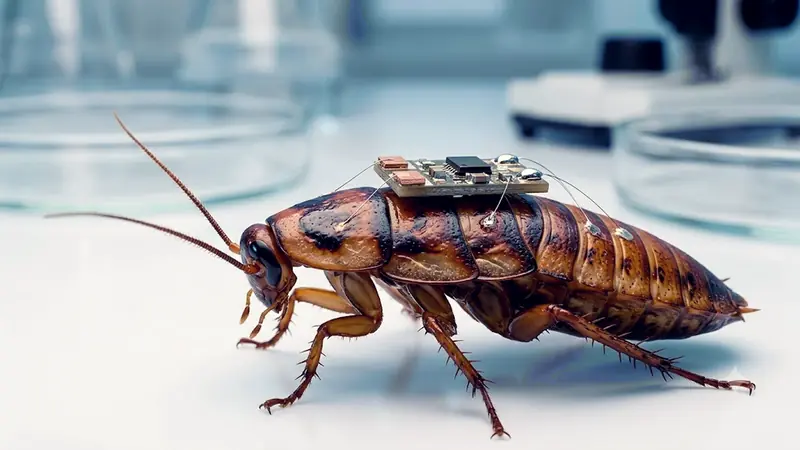
For years, this technology had a single bottleneck: power supply. Microbatteries drain, need replacing, and drastically limit field operation time. The solution the international scientific community is working on is as elegant as it is radical: turning the insect itself into a living power plant. At Case Western Reserve University, the milestone was achieved with an implantable biofuel cell, a device that uses specific enzymes to metabolize trehalose — the sugar cockroaches constantly produce from digesting food — converting it into electrical current usable to power onboard sensors and components. Tests ruled out harmful long-term effects on the organism, a finding that concretely paves the way for extended deployment without any need for energy-related maintenance.
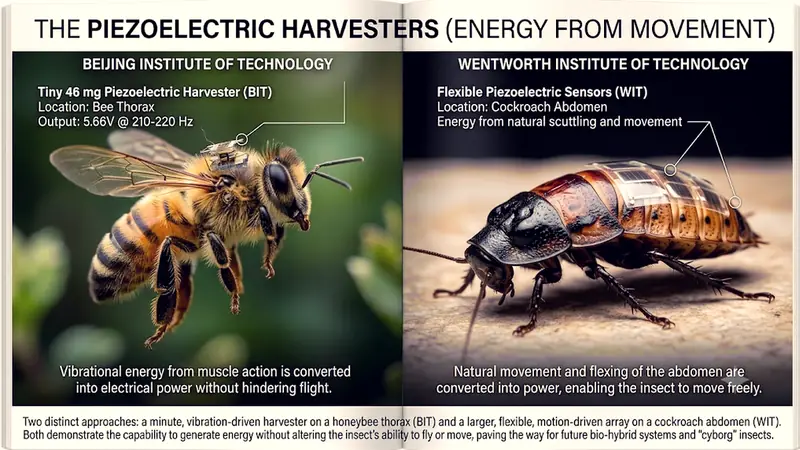
In parallel, piezoelectric energy harvesting is being developed — a physical principle that converts mechanical vibrations into current. The Wentworth Institute of Technology applied flexible sensors to cockroach abdomens, capable of capturing vibrations naturally produced by the insect's movement and turning them into a constant charge. On the flight front, the Beijing Institute of Technology developed a harvester weighing just 46 milligrams, calibrated to the bee's thoracic vibration frequency of 210 to 220 Hz, able to produce a voltage of 5.66 volts without affecting the insect's flight capability. Rounding out the picture, ultra-thin organic solar cells designed to be applied directly to the abdomen for ground-based applications are currently in the experimental stage.

From Rubble to Seabeds: Operational Scenarios
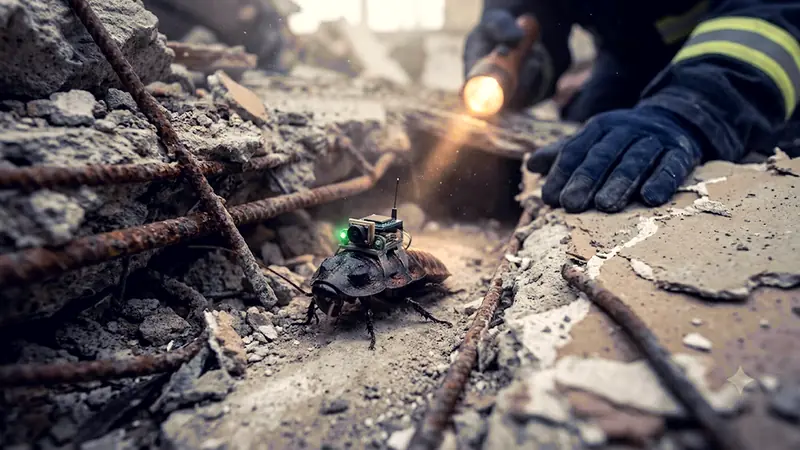
The range of possible applications is broad and spans widely different sectors. In humanitarian contexts, these hybrids' ability to infiltrate tight spaces makes them natural candidates for search-and-rescue operations after catastrophic events like earthquakes or floods, where piles of rubble often remain inaccessible even to the most sophisticated robots. To extend operations to underwater environments, a joint team from NTU Singapore and Waseda University designed a kind of miniature diving suit — a device that generates oxygen and allows the cockroach to move and survive underwater for up to three consecutive hours.
Applications don't stop at rescue work. Environmental monitoring — measuring pollutants or radiation levels in contaminated zones — and inspection of critical infrastructure like pipelines and industrial facilities represent other areas of active experimentation. On the military front, things get more delicate: German startup SWARM Biotactics has already carried out operational tests for clients tied to NATO, a clear signal of concrete interest in deploying swarms of cyborg insects for surveillance and reconnaissance in hostile scenarios, where these devices' low biological detectability offers a significant tactical advantage.
From Forced Control to Biological Listening
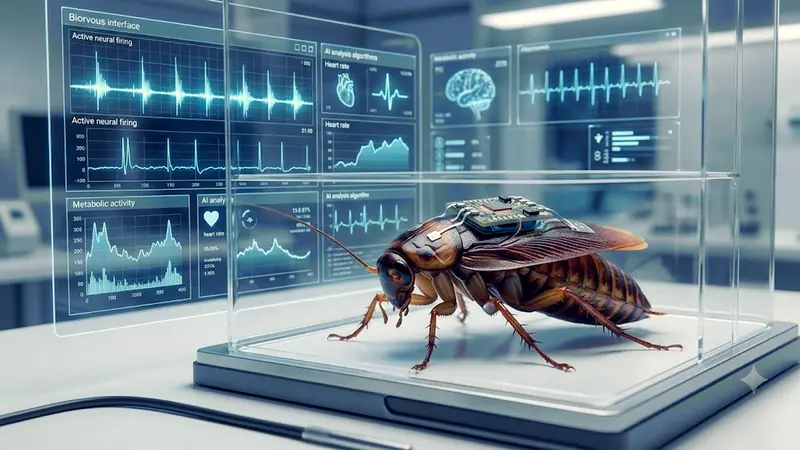
The most recent evolution in this research aims to move beyond the simple logic of externally imposed electrical commands. A team at Osaka University developed an artificial intelligence system capable of monitoring biological signals in real time — such as heart rate and neural activity — to estimate the insect's internal state and determine the optimal moment to apply an electrical stimulus. This marks a paradigm shift: no longer indiscriminately imposed control, but interaction calibrated to the organism's actual physiological conditions, aimed at maximizing operational efficiency while reducing stress on the insect. The research trajectory points toward a future where swarms of these bio-robots — energy self-sufficient and coordinated by increasingly sophisticated AI systems — become operational tools for exploring extreme environments otherwise out of reach for any fully artificial technology.