
Key Takeaways
- Biomechanical superiority: The Australian kestrel has over 22 degrees of freedom for wing and tail control, compared to just 4 in a conventional drone.
- Bio-inspired technology: Study conducted by RMIT University and the University of Bristol using wind tunnel testing and CT scans of live specimens.
- Commercial application: The research paves the way for drones capable of operating safely during deliveries, monitoring, and search missions, even in strong wind conditions.
The Raptor's Flight as an Engineering Model
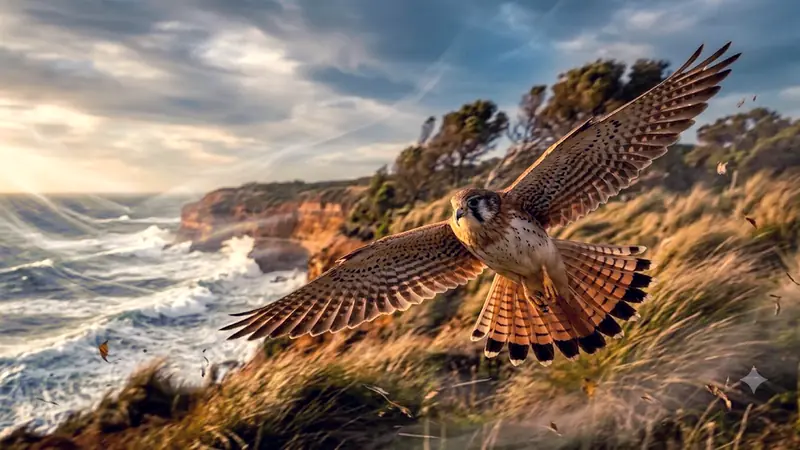
A small winged predator is redefining the boundaries of aerodynamics applied to unmanned aircraft. The nankeen kestrel, a bird of prey found across Australia, is at the center of a study conducted by researchers from RMIT University and the University of Bristol, who analyzed its behavior in a wind tunnel to understand how it maintains near-absolute stability even during turbulent gusts.

22 Degrees of Freedom Versus 4
The data collected reveals a substantial gap compared to current drones: the raptor possesses over 22 degrees of freedom in adjusting its wings and tail, versus just 4 available on an autonomous aircraft of comparable size. This capability allows the bird to correct its flight trajectory at twice the speed of a traditional drone. To verify the physical origin of this efficiency, the team built a robotic replica of the bird, based on CT scans of live specimens, and tested it under the same wind tunnel conditions.
Coordination, Not a Single Response
The results indicate that the key lies not in a single corrective mechanism, but in the simultaneous and continuous coordination between wings and tail. As researcher Matt Penn pointed out, birds don't respond to gusts with one isolated corrective action—they constantly adjust both structures to remain balanced. A principle that, if transferred to aeronautical engineering, could significantly expand drone operability in weather scenarios previously considered prohibitive.