Key Takeaways
- Daily output: the machine generates one gallon of synthetic gasoline per day (roughly 3.8 liters) and can store up to 64 liters.
- Technology used: direct air capture of CO₂ using a potassium hydroxide solution, water electrolysis, and catalytic Methanol-to-Gasoline (MTG) processing, originally patented by ExxonMobil in the 1970s.
- Device price: the current cost of the machine ranges between $15,000 and $20,000, with a stated goal of dropping to $5,000 once production scales up industrially.
The refrigerator that produces fuel
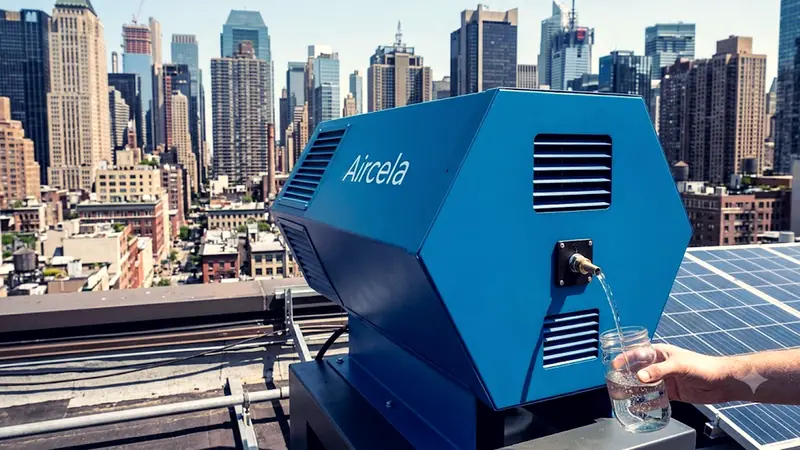
On a rooftop in Manhattan's Fashion District, a blue hexagonal box roughly the size of a commercial refrigerator runs around the clock, day and night, turning ordinary air into usable gasoline. This isn't science fiction, and it isn't a promotional render: it's the working prototype of Aircela, a startup founded in 2019 by Swedish engineers Mia and Eric Dahlgren. The machine doesn't simulate anything — it produces real fuel, ready to be poured into a tank, with no additives and no mechanical modifications to the engine.
The chemistry behind it, no frills
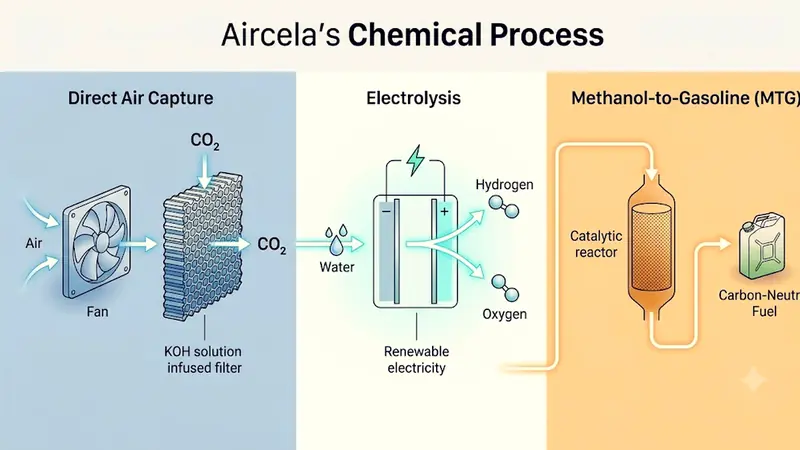
The system relies on three consecutive stages, none of which is entirely new to science, but their integration into a single compact device is what sets Aircela apart. The first stage is direct air capture of carbon dioxide: air is drawn in and passed through a potassium hydroxide-based solution capable of trapping about 10 kilograms of CO₂ per day. At the same time, water is split via electrolysis powered by renewable energy, separating hydrogen from oxygen. The resulting hydrogen is then reacted with the captured CO₂ inside a chemical reactor, producing methanol.
The final step converts that methanol into gasoline through the Methanol-to-Gasoline (MTG) catalytic process, a technology developed by ExxonMobil back in the 1970s and never fully abandoned by the petrochemical industry. The end product is a gasoline free of sulfur, ethanol, and heavy metals, with an octane rating of 90 or higher, compatible with any combustion engine without requiring mechanical changes.
The production numbers
According to Techsauce, the production cost of Aircela's synthetic gasoline sits below $1.50 per gallon, a figure made possible by off-grid solar panels that power the entire production cycle. In its current configuration, the machine produces one gallon of fuel per day, about 3.8 liters, with storage capacity reaching up to 17 gallons, or roughly 64 liters. Modest numbers compared to a traditional refinery, but enough to sketch out a decentralized production model never before seen in a device this size.
The Achilles' heel: energy efficiency
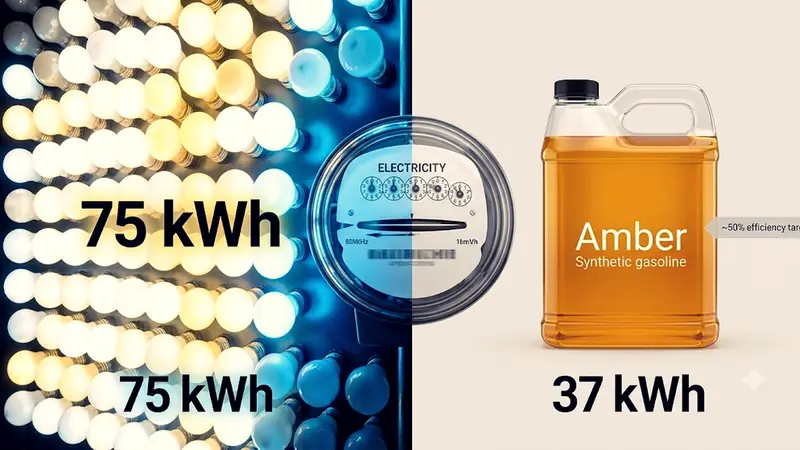
The project isn't without its issues, and the most glaring one concerns process efficiency. To produce a single gallon of gasoline, which holds about 37 kWh of energy, the machine consumes roughly 75 kWh of electricity. That ratio makes clear that, from a purely physical standpoint, synthesizing liquid fuel remains less efficient than using electricity directly in an electric vehicle. Aircela says it's targeting 50% efficiency, but that remains a goal yet to be reached, not an established figure.
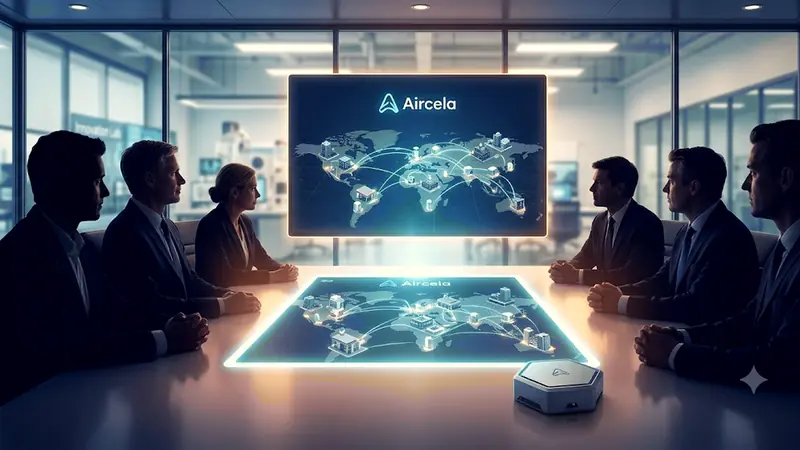
The device's accessibility raises questions of its own. According to The Autopian, the machine's estimated price currently sits between $15,000 and $20,000, a figure that limits its reach to a narrow pool of early adopters, companies, or specialized operators. The company has nonetheless set a clear target: bringing that down to $5,000 once large-scale production is achieved, a condition necessary to turn a niche device into a widely distributable product.
Investors and commercial outlook
Despite the technical challenges, Aircela has already caught the attention of heavyweight figures in the energy sector. Investors include Jeff Ubben, a board member at ExxonMobil, and Chris Larsen, founder of Ripple. Add to that the strategic backing of logistics giant Maersk, a signal of genuine interest from industrial players accustomed to evaluating technology on scalability, not media buzz.
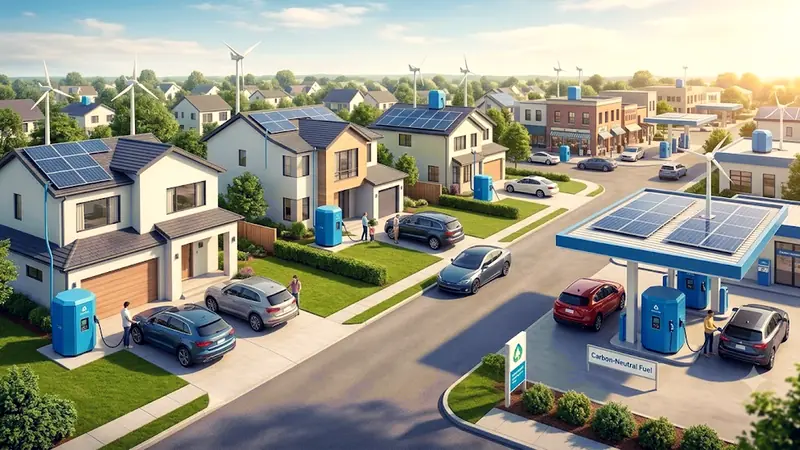
The first commercial installations are expected in the United States by the end of 2026. CEO Eric Dahlgren put it plainly: "We didn't build a prototype. We built a working machine." A statement that sums up the project's ambition: moving past the demonstration phase and toward a distributed network of machines, installable at homes, businesses, or fuel stations, capable of producing carbon-neutral fuel right where it's used, drawing on air as a theoretically infinite raw material.
A technology still being put to the test
It remains to be seen whether the model can withstand the pressures of mass production and whether energy efficiency can truly approach its stated targets. For now, the blue machine on that Manhattan rooftop stands as an isolated case, watched with curiosity by industry insiders and with skepticism by those who understand the physical limits of energy conversion. The road to widespread adoption still looks long, but the underlying principle — synthesizing fuel from air and water without fossil extraction — remains one of the most concrete attempts ever made in this direction.