Key Points
- The March 9, 2026 event: Chef Ryosuke Tamura hosted an exclusive symposium in Tokyo with 30 top chefs to demonstrate the culinary potential of the California prune in high-end Asian gastronomy.
- Technical fusion: Combination of Sichuan cuisine intensity, Japanese minimalism, and the nutritional versatility of the California prune to eliminate refined sugars and heavy fats.
- A paradigm shift: The prune transitions from simple snack to a structural, savory, and complex ingredient, capable of providing "Koku" (depth of flavor) and replacing chemical additives in Asian fine dining.
When Chinese Tradition Meets Japanese Minimalism: California Prune Conquers Tokyo
In the heart of Minami-Aoyama, Tokyo's most exclusive neighborhood, there exists a restaurant that has whispered its name through the circles of high Asian cuisine for years. It is called Juka (慈華), and its owner, chef Ryosuke Tamura, has built a reputation that goes far beyond simple fusion cooking. Born in 1977, with rigorous training in Sichuan and Taiwanese kitchens, Tamura represents a generation of chefs who have decided to reject the heaviness of traditional continental Chinese cuisine, instead embracing a philosophy that exalts the ingredient without suffocating it. His Michelin star is not merely a recognition: it is the validation of a vision that is slowly transforming how Asia thinks about food.
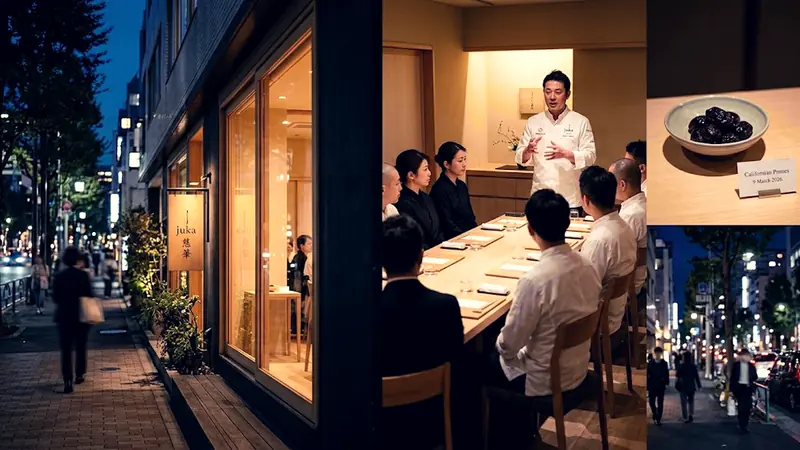
But what happens when a master of this caliber decides to put under the microscope a fruit that the Western world knows primarily as a snack or sweet treat? On March 9, 2026, Juka hosted an event that rarely emerges from the most restricted circles of international fine dining: an exclusive tasting symposium attended by approximately 30 of Tokyo's most influential chefs, convened by the California Prune Board for a demonstration that was meant to prove an apparently absurd thesis. The California prune, the very same fruit that millions of people eat distractedly as a natural remedy, could be the secret weapon of contemporary luxury Asian gastronomy.
The Deconstruction of a Fruit: Six Acts of Culinary Genius
Tamura designed a six-course menu that did not simply incorporate the prune, but used it as a structural foundation to challenge the most deeply rooted assumptions of modern cuisine. Each dish was a controlled experiment in culinary chemistry, and the result was a masterclass on how natural ingredients can completely replace synthetic additives without compromising flavor.
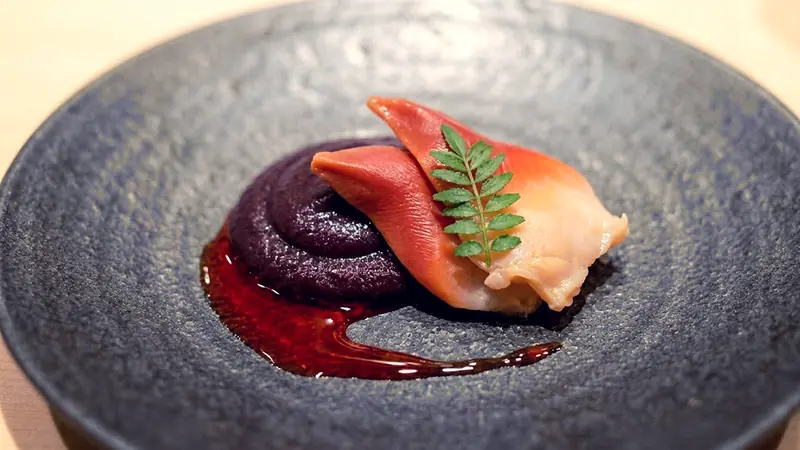
The appetizer was pure audacity: Akagai (the prized Japanese red clam) served raw, accompanied by a sauce that united Hong You, the potent Sichuan chili oil, with a puree of California prunes. Theoretically, sweet fruit should drown the delicacy of raw fish. Tamura proved otherwise. The initial violence of the chili strikes the palate like a punch, but immediately after comes the mature sweetness of the prune, which does not cover anything but rather creates a perfect sensory bridge toward the salty and delicate umami of the mollusk. It is a lesson in contrast: sweetness is not the enemy of salinity, when dosed with precision.
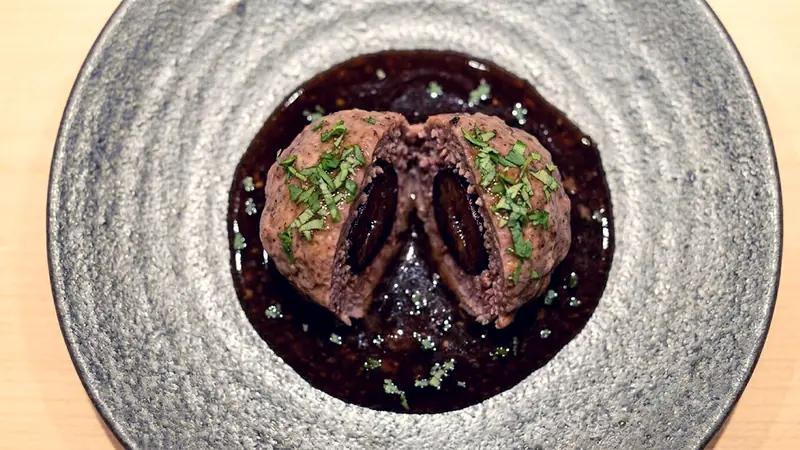
The next course revisited the legendary "Lion's Head" (Shizitou), the gigantic pork meatball of Chinese tradition that Tamura lightened using lamb. But the true innovation was hidden inside: a whole raw prune, protected by the meat, which does not cook in the sweet broth created by boiling other prunes. When the diner cuts into the meatball, the acidity of the raw prune explodes in the mouth, perfectly balancing the lamb's fat and the aroma of fresh herbs (cilantro, mint, dill). It is a trick of impeccable timing, a lesson in the temporal stratification of flavors.
The pork ribs steamed for two hours represented perhaps the most subtle stroke: accompanied by Ya Cai (fermented mustard greens) and prunes, the dish exploited a chemical fusion between the pungent and aged aroma of Ya Cai and the earthy sweetness of the prune. The result was a sensory illusion: the palate perceived that deep maturation (the Japanese Jukusei) that normally would require months of controlled fermentation. Tamura had compressed time using the synergy between ingredients.
The desserts that closed the menu were functional in the most literal sense: ginger ice cream served with prune compote marinated in Kurozu (prized Chinese black vinegar), and glutinous rice balls (Tangyuan) filled with prune paste and black sesame, immersed in a delicate hot rose tea broth. They were not desserts in the traditional sense, but rather tools for cleansing and regenerating the palate.
Why California, and Why Now
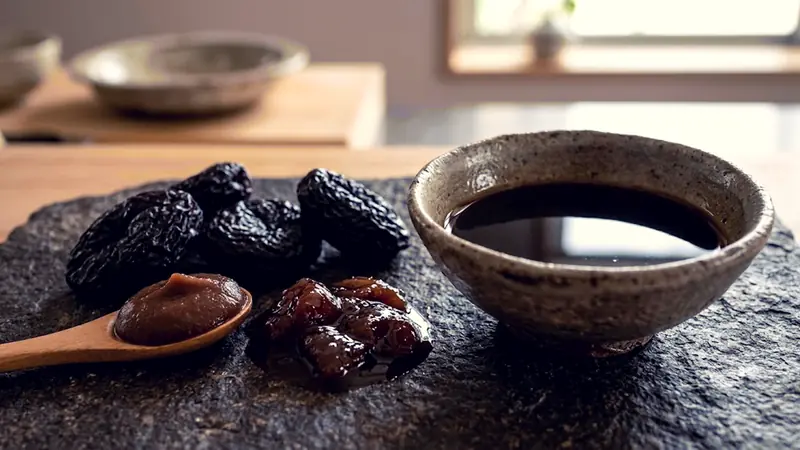
The California prune grows in the fertile valleys of Sacramento and San Joaquin, and unlike most commercially dried fruit, it contains no added sugars. But the technical reason for its sudden prominence in Asian fine dining goes beyond the simple absence of additives.
From a chemical standpoint, California prune puree provides what the Japanese call "Koku": body, richness, depth of flavor. At a historical moment when high Asian cuisine is abandoning the refined sugars and heavy fats that have characterized commercial Chinese cuisine for decades, the prune becomes the perfect compensator. It can replace both fats and synthetic sugars thanks to its natural consistency and high humectant power, which tenderizes meats and thickens sauces in a completely natural way.
What Tamura demonstrated on March 9 was not simply a culinary curiosity. It was tangible proof that high Asian cuisine is undergoing a transition toward Wellness Gastronomy, where the natural ingredient is not a limitation but a liberation. The California prune, in this context, is not a fruit: it is a technical solution that solves problems that modern cuisine had not yet admitted to having.