
Key Takeaways
- Selective contraction: Capital raised across MENA falls to $1.7 billion (-18% YoY) across 242 rounds, with deal count down 28%, signaling a market that is compressing transaction volume to concentrate heavier tickets.
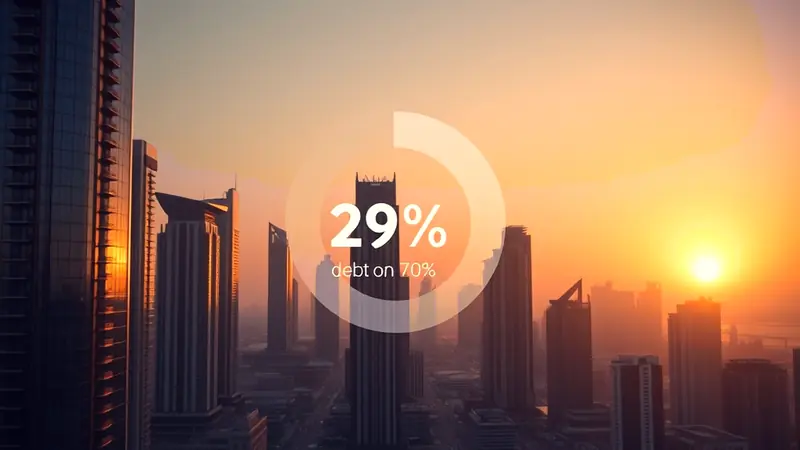
- Structural shift in funding mix: Debt financing collapses from 44% to 29% of the capital mix, while fintech dominates with $708 million, overtaken in Q2 by logistics on the back of isolated mega-rounds.
- Critical geographic concentration: The UAE absorbs 70% of regional capital (+125% YoY), while the top 10 deals account for 58% of the total and international capital participation drops from 48% to 19%.
Recalibration, Not Retreat: Reading the Aggregate Numbers
The first half of 2026 closes with $1.7 billion deployed across 242 funding rounds in the MENA startup ecosystem. The figure, down 18% from $2.1 billion in 2025, must be read alongside a 28% drop in deal count. The divergence between these two metrics is the real operational signal: the market isn't shrinking available capital, it's narrowing the pool of recipients, selecting for assets with verifiable growth trajectories.
Debt Loses Ground, Equity Reclaims Center Stage
Debt financing falls from 44% to 29% of total capital raised. This reduced reliance on debt as a growth lever points to a shift toward more sustainable capital structures, with investors returning to equity as a proxy for confidence in the business model rather than treating it as a short-term financial leverage tool.
Fintech, Logistics, Proptech: The Sector Map
Fintech remains the leading sector with $708 million across 51 rounds, confirming its role as enabling infrastructure for the broader ecosystem. The picture flips in the second quarter, when logistics overtakes fintech in absolute value on the strength of a handful of large-ticket deals, closing the half at $315 million total. Proptech ranks third with $241 million across 18 rounds. By stage, early-stage startups log 172 rounds worth $444 million, while later-stage companies raise just $224 million across only 11 deals, a ratio that confirms the scarcity of capital available for scale-up phases.
The UAE as the Region's Capital Concentration Point
The United Arab Emirates absorbs $1.2 billion across 83 deals, equal to 70% of total regional capital, up 125% year-over-year. Saudi Arabia follows with $259 million across 80 rounds, and Egypt rounds out the top three with $158.9 million across 29 deals, driven by local fintech activity worth $82.3 million. This concentration isn't a one-off: in the first quarter, the UAE had already captured 66.5% of regional venture funding, a share that intensifies further in Q2 according to MAGNiTT, which estimates a 22% decline to $1.35 billion for the same period.

Signs of Structural Stress
The region's 10 largest deals alone account for 58% of all capital raised, a level of concentration that exposes the entire ecosystem to idiosyncratic shocks. The slowdown in early-stage rounds, described by MAGNiTT as the most reliable gauge of real market appetite, points to tightening liquidity for early development stages. International investor participation drops from 48% to 19%, with local capital stepping in to fill the gap left by foreign players, reshaping the composition of systemic risk.
The gender gap in capital allocation is stark: male-founded startups capture roughly 95% of the total, $1.6 billion across 213 rounds, compared to just $2.5 million (0.14% of the total) raised by female founders across 14 transactions. The figure lays bare an allocation asymmetry that no aggregate growth metric can obscure.

Outlook: Consolidation on a Narrower Base
Global venture investment hits $510 billion in the first half of 2026, already surpassing the full-year total for 2025. MENA's performance, weighed down by regional tensions, moves against this expansive trend. The current architecture of regional capital, polarized around the UAE and a small number of mega-deals, points to an ecosystem consolidating on a narrower but potentially sturdier foundation. Any recovery will hinge on the ability to reactivate the flow toward early-stage rounds and reduce dependence on a handful of dominant hubs and deals.