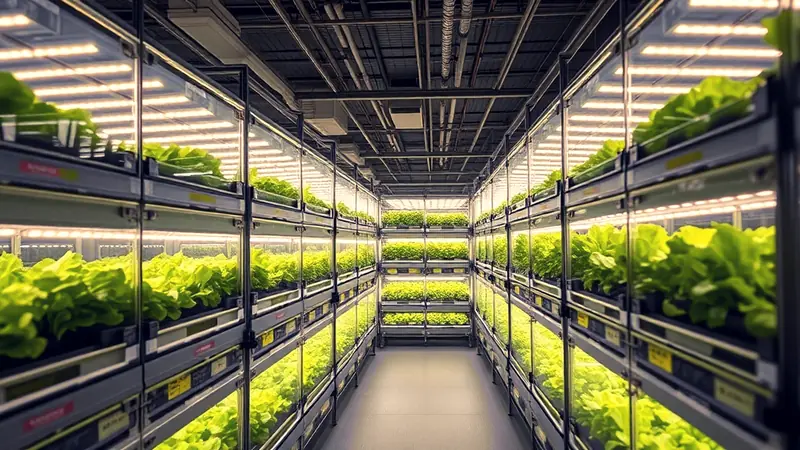
Key Takeaways
- Record efficiency in green hydrogen: Fraunhofer-ISE recorded 31.3% efficiency under real outdoor operating conditions using CPV (Concentrator Photovoltaics) systems directly coupled to PEM (Proton Exchange Membrane) electrolysis — no power converters, no conversion losses.
- Colossal storage scaling fast: Envision Energy is delivering a 1,600 MWh BESS (Battery Energy Storage System) in Lower Saxony; TEPCO and Daiwa House are targeting 4 GWh of national grid-scale storage across Japan by 2035.
- End-of-life regulation tightens: JPEA (Japan Photovoltaic Energy Association) has overhauled the Solar Week Award 2026 criteria, making environmental coexistence and module recycling mandatory benchmarks for the entire photovoltaic industry.
The global energy system is shedding its skin: no longer plants, but ecosystems
The paradigm has shifted. The conversation is no longer about isolated wind towers or rooftop panels bolted onto industrial warehouses. The global energy infrastructure is evolving into something far more complex, more ambitious, and — in its underlying logic — more unforgiving: interconnected ecosystems where generation, storage, and end-of-life material management form a single, closed cycle. The operational data emerging from 2026 paints a picture in which the energy transition is no longer a political promise. It is an open construction site running at industrial scale.
Energyfish: the micro-turbines swimming in the Rhine
Start with water. Energyminer is harvesting the results of its floating hydrokinetic (energy extracted from flowing water without dams) system on the Rhine, where the first swarm-structured deployment — one hundred and twenty-four units of the Energyfish module anchored just below the water surface — is delivering operational data that confirms the full scalability of the technology. No dam. No impact on fish populations. No disruption to river navigation. The micro-turbines run silently, twenty-four hours a day, seven days a week, converting current into steady, measurable power output.
The value of this deployment is not purely technical. It is the large-scale validation of a distributed hydroelectric model that can be replicated rapidly, without the bureaucratic and environmental complexity that comes with large dam projects. For communities seeking reliable, fast-to-install energy sources, Energyfish is a concrete answer — not a laboratory experiment.
Fraunhofer-ISE: 31.3% efficiency, and the converter disappears
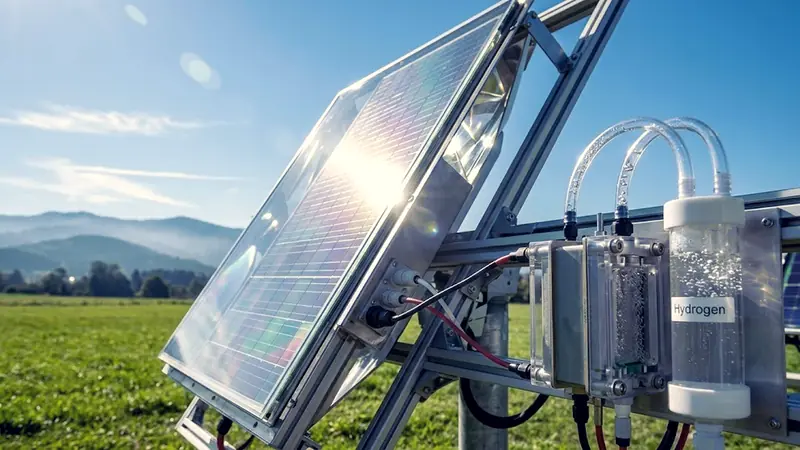
On the solar generation front, the breakthrough belongs to the Fraunhofer-ISE Institute, which has recorded a landmark efficiency of 31.3% under real outdoor operating conditions. Not in a cleanroom. Not in simulation. Outside, under actual sunlight. The system uses CPV (Concentrator Photovoltaics) modules equipped with III-V multijunction solar cells — the same cell architectures originally developed for space applications — coupled directly to PEM electrolysis cells for green hydrogen production.
The decisive technical move is the elimination of electronic power converters. Direct transmission between the photovoltaic array and the electrolyzer eliminates conversion losses entirely, optimizing the LCOH (Levelized Cost of Hydrogen, the benchmark metric for hydrogen production economics) and maximizing yield per installed square meter. In a sector where every percentage point of efficiency translates to millions at industrial scale, a jump to 31.3% under real-world conditions is not a footnote.
Gigawatts of storage: Germany and Japan move heavy pieces
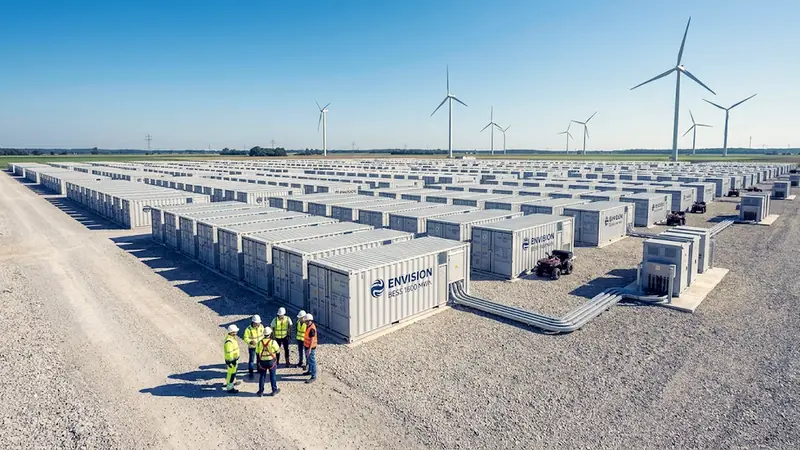
Generating clean energy is half the problem. The other half is called intermittency (the irregular, unpredictable output of renewable sources), and it can only be solved through storage. On this front, the moves of 2026 operate at a scale that commands attention. In Lower Saxony, Envision Energy is delivering to Elements Green a battery storage system rated at 1,600 MWh, engineered for four-hour discharge cycles. An asset built not to experiment, but to concretely stabilize the German energy market — one of the most complex and volatile in Europe.
On the other side of the planet, in Japan, a different kind of alliance is taking shape. Tokyo Electric Power Company — TEPCO — and Daiwa House Industry have signed a joint venture with a stated objective: 4 GWh of grid-scale storage capacity across the national network by 2035. The operation fuses complementary expertise with surgical precision: Daiwa brings its real estate capability in site acquisition and development; TEPCO brings the technological infrastructure and grid management. The expected outcome is a critical network capable of absorbing renewable fluctuations at a national scale.
End-of-life and circularity: the industry starts accounting for its own waste
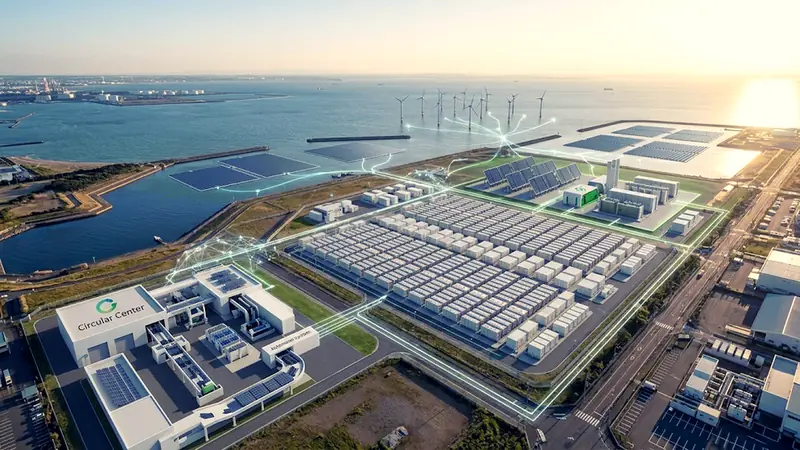
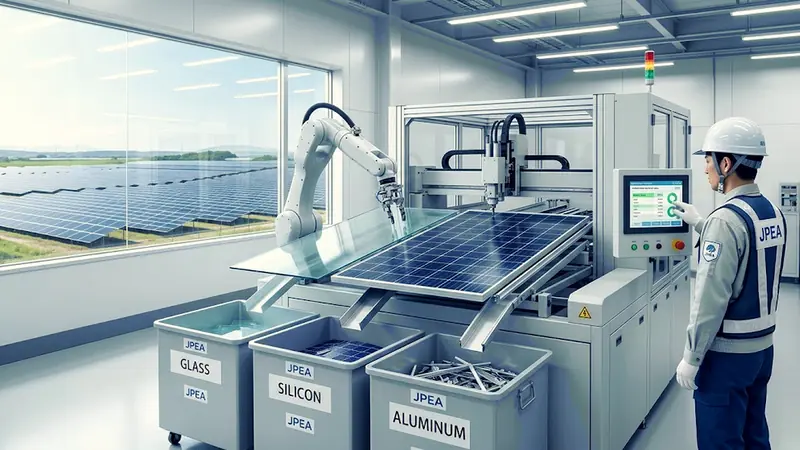
Infrastructure expansion carries a cost that rarely makes it into press releases: tonnes of materials reaching end-of-life that, without a structured recovery pipeline, become an environmental liability of industrial proportions. Japan's photovoltaic sector is acutely aware of this, and the Japan Photovoltaic Energy Association — JPEA — has moved with a precise regulatory instrument. The revised criteria for the Solar Week Award 2026 place environmental coexistence and module recycling from large-scale solar installations at the center of evaluation, effectively establishing a new accountability standard for the entire industry.
In Thailand, the Gesellschaft für Internationale Zusammenarbeit — GIZ (Germany's federal agency for international development cooperation) — has extended the strategic MA-RE-DESIGN project by four years. The initiative works to build the regulatory and industrial framework needed to transform plastic waste into tangible resources, aiming to anchor the region within circular economy (a system where waste is eliminated by reusing materials) principles in a systemic, not episodic, way.
The framework: three pillars, no shortcuts
Taken together, these developments trace a precise architecture. The energy transition of 2026 rests on three interdependent pillars: innovation in generation — Energyfish, III-V cells, 31.3% real-world efficiency — the engineering of colossal storage assets such as those deployed by Envision and TEPCO, and the stringent lifecycle governance imposed by JPEA and GIZ. Three axes that do not function in isolation. Either the complete ecosystem is built, or nothing is built at all.