
Key Takeaways
- Superior mechanical performance: Timber produced using the Daisugi technique is 140% more flexible and 200% denser and stronger than cedar grown through standard cultivation methods.
- Technology and origin: Daisugi is a precision silviculture (science of controlled forest cultivation) technique developed in the 14th century in the Kitayama region, north of Kyoto, applied specifically to Japanese cedar.
- International expansion: Several European countries, with France leading through active regional programs, are launching direct trials to implement Daisugi within their own forest ecosystems.
A Medieval Technique Back on the Frontline
In the middle of one of the most complex ecological transitions the global production sector has ever faced, the most concrete answer to climate urgency comes from a forestry practice developed in the 14th century. This is not a metaphor, nor an exercise in nostalgia. It is applied botanical engineering, born out of necessity and now reread as one of the most operationally relevant models for contemporary silviculture and sustainable construction supply chains.
The setting is the mountainous region of Kitayama, north of Kyoto. A structural shortage of cultivable land and a growing demand for high-grade timber for traditional Japanese architecture created the conditions for a radical solution. From that pressure, Daisugi was born: a technique capable of multiplying wood production without felling a single tree, designed to yield perfectly smooth, knot-free trunks destined for the load-bearing structures and interiors of the architectural complexes of the era.
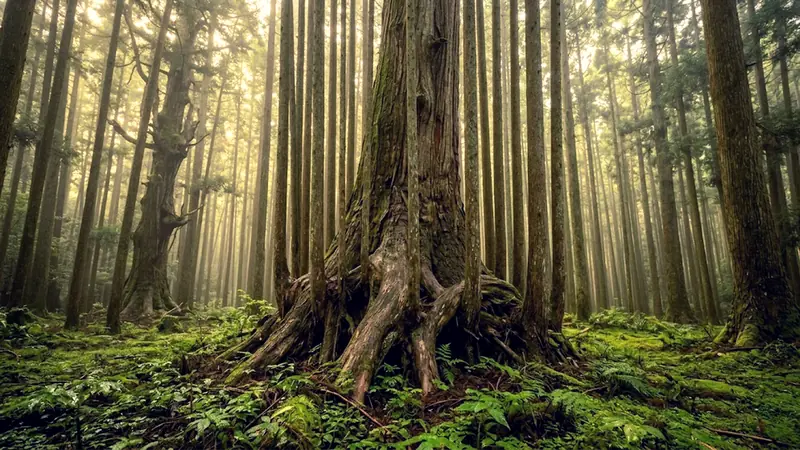
The Mechanism: Botany as Industrial Design
The Daisugi process transforms the Kitayama cedar into a continuous production system. The mother tree is severely pruned at the base, taking on the form of a monumental bonsai (miniature tree shaped by controlled pruning) from which dozens of new shoots grow vertically. Maintenance is manual and scheduled: lateral branches are removed every two to four years, preventing the formation of knots in the growing wood. This is a surgical intervention repeated over time, not a simple pruning.
The mechanical outcome of this process is measurable and documented. Fed by the root system of a mature, centuries-old tree, the new stems develop structural characteristics that conventionally grown cedar cannot match: the timber produced is 140% more flexible and 200% denser and stronger than the standard. Figures that, in the current context of construction materials, carry a specific weight that is hard to ignore.
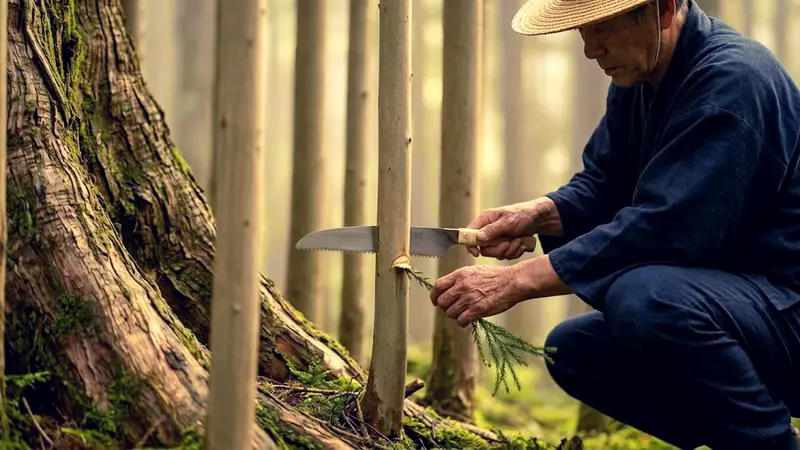
The spatial efficiency of the system is equally significant. A single mother tree, with a productive lifespan that can extend to six hundred years, is capable of simultaneously sustaining the growth of approximately one hundred stems, ready for harvest in cycles of just twenty years. The yield per unit of surface area is radically superior to that of traditional plantations, with a minimal land footprint.
Carbon, Soil, and the Geometry of a Permanent Sink
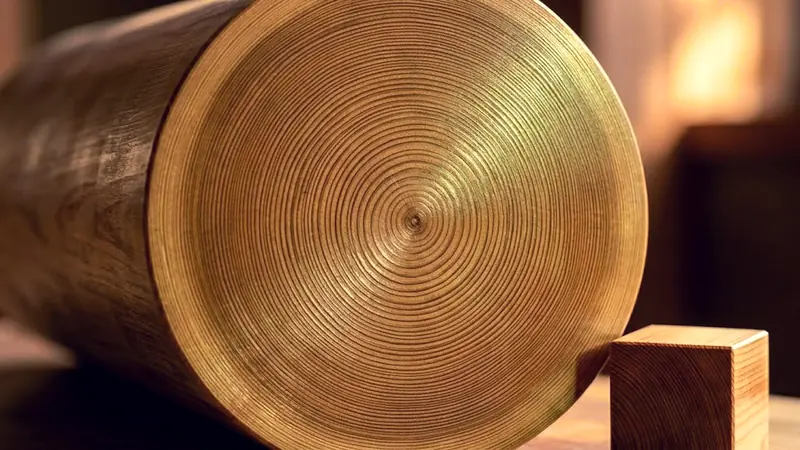
The absence of clear-cutting (complete removal of all trees in an area) is the point where Daisugi stops being a historical curiosity and becomes an instrument of environmental policy. By eliminating total felling, the technique preserves the entire root system of the mother tree. The soil undergoes no erosion. The microbial network (underground ecosystem of fungi and bacteria) remains intact. And critically, the carbon dioxide stored in the biomass and the soil is not released into the atmosphere, turning every mother tree into a permanent, active carbon sink.
At a moment when carbon markets and deforestation regulations are reshaping the forestry strategies of entire continents, this mechanism carries a value that goes well beyond the symbolic. The root system of a centuries-old cedar continuing to function for six centuries is, in practical terms, a natural sequestration infrastructure.
Europe Experiments, France Leads
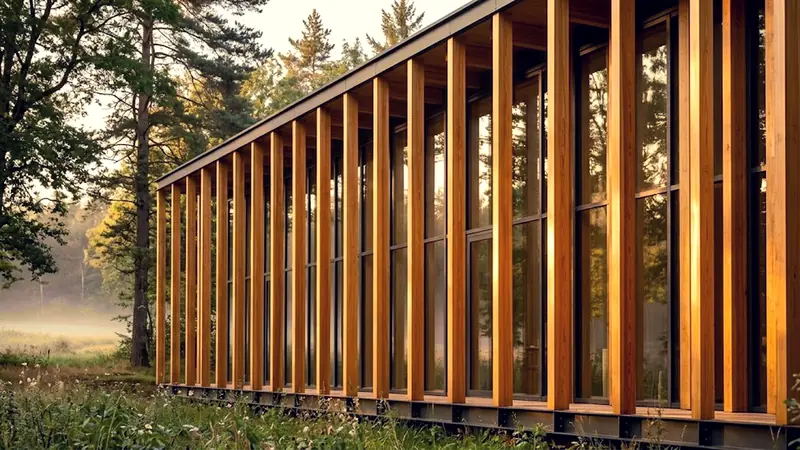
The operational validity of this paradigm has already crossed Japan's borders. Several European nations have launched direct experimentation programs to assess the applicability of Daisugi to their own forest ecosystems. France is positioned at the forefront, with multiple active regional programs testing the adaptation of the technique to local species and pedoclimatic (relating to soil and climate conditions) variables. This is not cultural imitation — it is applied technology transfer in forest management.
The data emerging from this expansion is precise: Daisugi is not being adopted for aesthetic or ideological reasons, but because its measurable performance — timber quality, spatial yield, sequestration capacity — meets concrete requirements that conventional models struggle to satisfy simultaneously.
An Ecological Imperative Translated into Competitive Advantage
For the forestry sector and the supply chains tied to architecture and construction, Daisugi represents an empirical proof of a principle that the sustainability debate often struggles to embody: environmental compliance does not require a compromise on the quality of the final product. On the contrary, in this specific case, it elevates quality to levels structurally superior to the market standard. A technique developed in the 14th century to address a local resource crisis now finds itself, in 2026, delivering measurable answers to a global one.